Curtain Wall Sealant Selection Guide for High-Rise Buildings

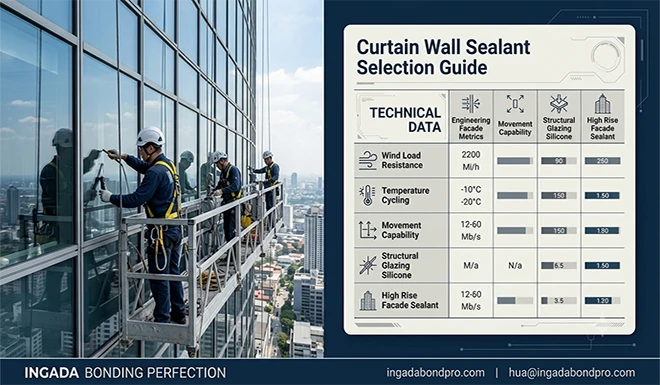
Introduction: Why Curtain Wall Sealant Selection Matters in High-Rise Buildings
Modern high-rise buildings depend on advanced facade systems to withstand demanding environmental conditions.
Unlike low-rise structures, high-rise facades experience continuous mechanical stress from:
- Strong wind pressure and suction;
- Daily temperature fluctuations;
- Building sway and structural movement;
- Long-term UV exposure;
- Rain penetration risks.
A curtain wall sealant is not simply a waterproofing material. It is an engineered component that maintains the connection between glass, aluminum frames, panels, and building structures throughout the service life of the facade.
For high-rise projects, selecting the correct high rise facade sealant requires evaluating:
- Adhesion performance;
- Movement capability;
- Elastic recovery;
- Resistance to dynamic pressure;
- Temperature cycle durability;
- Compatibility with facade materials.
Structural glazing silicone remains a key technology for glass curtain wall systems, while advanced hybrid/MS polymer sealants provide additional solutions for high-movement facade joints and weatherproof applications.
2. Understanding Curtain Wall Sealant Requirements in High-Rise Buildings
2.1 Wind Load and Dynamic Pressure Resistance
Wind pressure increases significantly with building height.
High-rise curtain walls must resist:
- Positive wind pressure;
- Negative wind suction;
- Repeated pressure cycling;
- Frame deformation caused by structural movement.
During wind events, facade joints experience repeated loading:
Wind pressure → Frame movement → Sealant deformation → Elastic recovery
A suitable sealant must absorb these movements without:
- Adhesion failure;
- Cohesive cracking;
- Permanent deformation.
2.2 Extreme Temperature Cycles
High-rise buildings experience continuous thermal expansion and contraction.
Typical challenges include:
- Day/night temperature differences;
- Seasonal temperature changes;
- Solar heating of glass facades;
- Freeze-thaw cycles.
Sealant performance depends on:
- Low-temperature flexibility;
- High-temperature stability;
- Long-term elasticity;
- Resistance to fatigue.
2.3 Building Movement and Structural Displacement
Tall buildings naturally move because of:
- Wind-induced sway;
- Thermal expansion;
- Structural settlement;
- Seismic activity.
Therefore, facade sealants must have sufficient movement capability.
Common movement classes:
| Movement Class | Capability | Typical Application |
|---|---|---|
| Class 20 | ±20% | Standard facade joints |
| Class 25 | ±25% | General curtain wall systems |
| Class 35 | ±35% | High-performance facade joints |
| Class 50 | ±50% | Extreme movement and seismic applications |
INGADA’s MS Weatherproof Sealant Series includes products designed for Class 25 to Class 50 movement requirements, including MS-625, MS-635, and MS-650.
3. Structural Glazing Silicone vs Weatherproof Curtain Wall Sealant
High-rise facade projects often require two different sealant functions:
- Structural bonding
- Weatherproof sealing
These applications should not be confused.
Structural Glazing Silicone
Structural glazing silicone is designed to bond glass panels to supporting structures.
Typical applications:
- Structural glazing systems;
- Glass curtain walls;
- Unitized facade systems.
Key advantages:
- High tensile strength;
- Excellent UV resistance;
- Long-term weather stability;
- Proven facade performance.
INGADA structural silicone products such as SR-100 and SR-102 are designed for structural glazing applications and reference ASTM C1184 compliance.
Weatherproof Curtain Wall Sealant
Weatherproof sealants protect facade joints from:
- Water infiltration;
- Air leakage;
- Environmental exposure.
Typical applications:
- Aluminum frame joints;
- Expansion joints;
- Curtain wall perimeter sealing.
MS Polymer and silicone weatherproof sealants can provide high movement capability depending on formulation and classification.
4. Technical Comparison Matrix: High-Rise Facade Sealant Selection
| Performance Factor | Structural Glazing Silicone | MS Polymer / Hybrid Sealant | Engineering Importance |
|---|---|---|---|
| Structural Bonding | Excellent | Application dependent | Critical for glass bonding |
| UV Resistance | Excellent | Excellent | Outdoor facade durability |
| Movement Capability | High | High | Handles building movement |
| Dynamic Pressure Resistance | Excellent | Excellent when properly specified | Wind load performance |
| Paintability | Limited | Excellent | Important for finishing |
| Substrate Compatibility | Strong on glass/aluminum | Very broad | Material flexibility |
| Temperature Resistance | Excellent | Excellent | Extreme climate performance |
| Primer Requirement | Often required depending on substrate | Often reduced | Installation efficiency |
| Long-Term Elasticity | Excellent | Excellent | Joint durability |
5. Weighted Engineering Scoring Matrix
For high-rise facade applications, engineers typically evaluate multiple factors.
| Criteria | Weight | Structural Silicone | MS Polymer Hybrid |
|---|---|---|---|
| Structural Strength | 25% | 10/10 | 8/10 |
| UV Resistance | 20% | 10/10 | 9/10 |
| Movement Capability | 20% | 9/10 | 10/10 |
| Weather Resistance | 15% | 10/10 | 9/10 |
| Installation Flexibility | 10% | 7/10 | 10/10 |
| Paintability | 10% | 3/10 | 10/10 |
Engineering Interpretation
Structural glazing silicone:
Best choice for:
- Glass bonding;
- Structural facade systems;
- Certified glazing applications.
MS Polymer hybrid sealant:
Best choice for:
- High movement joints;
- Mixed-material facades;
- Projects requiring paintability and broad adhesion.
6. Standards Guide for Curtain Wall Sealant Selection
ASTM C1184: Structural Silicone Sealant Standard
ASTM C1184 applies to structural silicone sealants used in structural glazing applications.
Important evaluation factors:
- Tensile strength;
- Adhesion;
- Durability;
- Movement capability.
INGADA SR-100 and SR-102 structural silicone products are positioned for curtain wall and structural glazing applications.
ASTM C920: Elastomeric Joint Sealants
ASTM C920 evaluates construction joint sealants.
Key performance areas:
- Adhesion;
- Elastic recovery;
- Movement classification;
- Weather durability.
INGADA MS-625, MS-635, and MS-650 products are designed for weatherproof and expansion joint applications with movement capability from ±25% to ±50%.
EN Facade Classification Considerations
European facade systems commonly evaluate:
- Air permeability;
- Watertightness;
- Resistance to wind load;
- Thermal cycling performance.
For curtain wall projects, sealant selection should consider the complete facade system rather than isolated material properties.
7. Movement Capability Under Dynamic Pressure
Why Movement Capability Matters
A high-rise facade joint does not move once.
It moves repeatedly.
Daily cycles include:
- Wind pressure deformation;
- Thermal expansion;
- Structural vibration;
- Long-term fatigue.
A sealant with insufficient movement capability may experience:
- Edge tearing;
- Cohesive cracking;
- Water leakage.
Dynamic Pressure Performance Logic
Low Movement Requirement
Typical:
- Small commercial buildings;
- Protected facade joints.
Recommended:
Class 20–25 sealants.
Medium Movement Requirement
Typical:
- High-rise curtain walls;
- Large facade systems.
Recommended:
Class 35 sealants.
INGADA MS-635 provides ±35% movement capability and is designed for demanding applications including curtain walls, bridges, and seismic zones.
Extreme Movement Requirement
Typical:
- Super-tall buildings;
- Seismic regions;
- Long-span structures.
Recommended:
Class 50 sealants.
INGADA MS-650 provides ±50% movement capability for high-movement structures.
8. High-Rise Curtain Wall Sealant Selection Guide
| Application | Recommended Technology | Example Products |
|---|---|---|
| Structural glazing | Structural glazing silicone | SR-100 / SR-102 |
| Glass curtain wall assembly | Silicone structural sealant | SR Series |
| Facade perimeter sealing | Weatherproof sealant | Silicone / MS Polymer |
| High movement facade joints | MS Polymer hybrid | MS-635 |
| Super-tall building expansion joints | High movement sealant | MS-650 |
| Prefabricated facade systems | Low modulus sealant | MS-625 |
9. How to Select the Right Curtain Wall Sealant
Before specifying a sealant, project teams should evaluate:
1. Facade Function
Is the sealant:
- Structural?
- Weatherproof?
- Expansion joint?
- Perimeter sealing?
2. Expected Movement
Calculate:
- Thermal movement;
- Wind deformation;
- Structural displacement.
3. Substrate Compatibility
Consider:
- Glass;
- Aluminum;
- Concrete;
- Stone;
- Composite panels.
4. Environmental Exposure
Evaluate:
- UV intensity;
- Temperature range;
- Humidity;
- Pollution exposure.
10. Frequently Asked Questions (FAQ)
Q1: What sealant is best for high-rise curtain walls?
The best sealant depends on the application.
Structural glazing systems typically require structural silicone, while facade joints may require high-movement weatherproof sealants.
Q2: What is the difference between structural glazing silicone and curtain wall sealant?
Structural glazing silicone provides bonding strength for glass attachment.
Curtain wall sealant generally refers to weatherproof sealing materials used to protect joints.
Q3: How much movement capability does a high-rise facade need?
It depends on:
- Building height;
- Climate;
- Wind conditions;
- Structural design.
High-movement projects may require Class 35 or Class 50 sealants.
Q4: How do temperature cycles affect facade sealants?
Repeated heating and cooling create expansion and contraction forces.
Sealants must maintain elasticity to prevent cracking and leakage.
Q5: Can MS Polymer replace structural silicone?
Not generally for structural glazing applications.
Structural glazing requires tested structural silicone systems.
MS Polymer is more suitable for weatherproof joints, bonding applications, and high-movement sealing.
11. Conclusion
Selecting the correct curtain wall sealant is a critical engineering decision for high-rise buildings.
A successful facade sealing system must withstand:
- Dynamic wind pressure;
- Extreme temperature cycles;
- Structural movement;
- Long-term environmental exposure.
For structural glazing applications, structural glazing silicone remains the established solution.
For high-movement facade joints, expansion systems, and mixed-material applications, advanced hybrid/MS polymer sealants provide additional flexibility and installation advantages.
The correct choice depends on understanding:
- Building movement;
- Joint design;
- Environmental conditions;
- Performance standards.
A properly selected sealant system helps ensure safer, more durable, and longer-lasting high-rise facade performance.
Discover more from INGADA The Ultimate Bonding Expert
Subscribe to get the latest posts sent to your email.