How Sealants Protect Glass Curtain Walls from Water Leakage

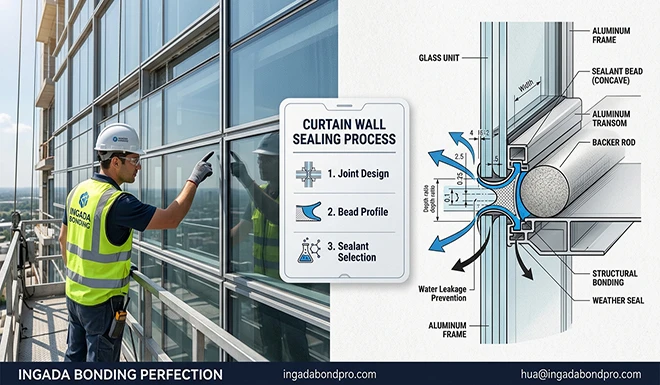
Why Curtain Wall Leakage Happens
Modern glass curtain walls are designed to provide:
- Natural lighting
- Architectural aesthetics
- Energy efficiency
- Weather protection
However, water leakage remains one of the most common failures in facade systems.
Most leakage problems are not caused by glass panels themselves. They usually occur at:
- Panel joints
- Frame connections
- Sealant interfaces
- Expansion gaps
- Drainage nodes
A curtain wall system depends on a combination of:
- Correct joint geometry
- Proper sealing bead design
- Suitable sealant selection
When these three elements work together, sealants create a flexible waterproof barrier that protects buildings from rain penetration and long-term weather damage.
The Role of Sealants in Glass Curtain Wall Systems
A sealant in a curtain wall is not simply a filling material.
It performs multiple engineering functions:
1. Water Barrier
Sealants block external moisture from entering through:
- Glass-to-frame joints
- Panel connections
- Expansion gaps
2. Movement Accommodation
Buildings experience movement caused by:
- Thermal expansion
- Wind pressure
- Structural deformation
- Seismic activity
A rigid sealant may crack when joints move.
A high-performance sealant maintains adhesion while absorbing movement.
3. Weather Protection
Facade sealants must resist:
- UV exposure
- Temperature cycles
- Rainwater
- Atmospheric aging
Curtain Wall Node Sealing Process: Three Critical Engineering Factors
1. Joint Geometry Design
The first step in leak prevention is correct joint design.
A curtain wall joint must consider:
- Joint width
- Joint depth
- Movement capability
- Bonding surface area

The sealant should not be installed as a simple filler.
Correct geometry allows the sealant bead to:
- Expand
- Compress
- Recover after movement
Joint Geometry Principles for Curtain Wall Sealing
Width-to-Depth Ratio
For elastic sealants, proper width-to-depth control is essential.
Typical principles:
| Joint Condition | Recommended Approach |
|---|---|
| Narrow joints | Ensure sufficient sealant depth |
| Large movement joints | Increase width for flexibility |
| Deep joints | Use backer rod to control depth |
| Structural joints | Follow engineering specifications |
Incorrect geometry can create:
- Three-sided adhesion
- Internal stress concentration
- Early cracking
2. Sealant Bead Profile Design
The shape of the sealant bead directly affects performance.
Correct Concave Bead Profile
A properly designed sealant bead should usually have a slightly concave profile.
Advantages:
- Better movement absorption
- Reduced stress concentration
- Improved water runoff
Incorrect Profiles
Flat Surface
Problems:
- Higher stress during movement
- Reduced flexibility
Excessively Deep Sealant
Problems:
- Slow curing
- Internal stress
- Reduced durability
3. Sealant Selection for Leak Prevention
Not all sealants are suitable for glass curtain walls.
The correct choice depends on:
- Glass system design
- Movement requirements
- Weather exposure
- Structural requirements
Silicone vs MS Polymer vs PU Sealant for Curtain Walls
| Performance Factor | Silicone Sealant | MS Polymer Sealant | PU Sealant |
|---|---|---|---|
| UV Resistance | Excellent | Excellent | Medium |
| Glass Compatibility | Excellent | Good | Medium |
| Movement Capability | Excellent | Excellent | Good |
| Paintability | No | Yes | Limited |
| Structural Bonding | Excellent | Excellent | Good |
| Outdoor Durability | Excellent | Excellent | Medium |
| VOC Profile | Medium | Low | Medium |
| Primer Requirement | Application dependent | Often lower | Often required |
Why Silicone Remains Important for Glass Curtain Walls
Silicone structural sealants remain widely used in:
- Structural glazing systems
- Glass curtain wall assembly
- High-rise facade projects
Advantages:
- Excellent UV resistance
- Long service life
- High temperature resistance
For structural glazing applications, silicone products are commonly evaluated according to standards such as ASTM C1184.
INGADA structural silicone series includes ASTM C1184 compliant products designed for curtain wall assembly and structural glass bonding applications.
Where MS Polymer Sealants Are Increasingly Used
Hybrid MS Polymer sealants are becoming popular for facade applications requiring:
- Paintability
- Lower odor
- Broad substrate compatibility
- Flexible sealing performance
INGADA MS weatherproof sealants are designed for high-movement facade applications, including curtain walls, prefab buildings and infrastructure joints.
Engineering Comparison: How Sealant Prevents Water Leakage
| Failure Risk | Sealant Solution |
|---|---|
| Joint movement cracking | High elongation sealant |
| UV aging | Weather-resistant polymer system |
| Poor adhesion | Correct substrate compatibility |
| Water penetration | Continuous sealing bead |
| Sealant failure | Proper joint geometry |
Common Curtain Wall Leakage Failure Causes
1. Incorrect Sealant Selection
Example:
Using an interior sealant for an exposed facade.
Result:
- UV degradation
- Loss of elasticity
- Leakage
2. Poor Surface Preparation
Contamination from:
- Dust
- Oil
- Moisture
can reduce adhesion.
3. Wrong Joint Design
Common problems:
- Too thin sealant layer
- No movement allowance
- Incorrect backer rod installation
4. Aging Sealant
Long-term exposure causes:
- Hardening
- Cracking
- Adhesion loss
Recommended Sealant Selection Guide for Curtain Wall Projects
| Application | Recommended Sealant Type |
|---|---|
| Structural glass bonding | Structural silicone |
| Exterior weather sealing | Weatherproof silicone / MS polymer |
| High movement joints | Low modulus MS polymer |
| Painted facade surfaces | MS polymer |
| Metal and mixed substrate bonding | Hybrid MS polymer |
Example: High Movement Curtain Wall Applications
For buildings exposed to:
- Strong wind loads
- Temperature changes
- Seismic movement
sealants need high elasticity.
INGADA MS-650 provides:
| Parameter | Performance |
|---|---|
| Movement Class | ±50% |
| Elongation | ≥780% |
| Temperature Range | -40°C to 90°C |
| Application | Super-tall buildings, seismic zones |
FAQ: Glass Curtain Wall Sealant Questions
Why do glass curtain walls leak?
Most leakage occurs because of:
- Poor joint design
- Incorrect sealant selection
- Aging sealant
- Installation defects
What sealant is best for glass curtain walls?
The best sealant depends on the application.
- Structural glazing → structural silicone
- Weather sealing → silicone or MS polymer
- Painted facade → MS polymer
How often should curtain wall sealants be replaced?
Service life depends on:
- Sealant quality
- Climate conditions
- Installation quality
- Building movement
Regular facade inspection is recommended.
Can MS polymer replace silicone in curtain walls?
For some weather sealing applications, yes.
However, structural glazing systems may still require silicone products designed specifically for structural bonding.
How Global Facade Contractors Select Sealant Suppliers
Professional buyers evaluate:
Technical Capability
- ASTM compliance
- Movement classification
- Testing data
- TDS documentation
Supply Capability
- Stable production
- Batch consistency
- OEM support
Compliance
- REACH
- RoHS
- VOC requirements
INGADA operates under ISO 9001 quality management and provides compliance documentation including REACH, RoHS, French VOC A+, FDA and relevant ASTM standards depending on product category.
Conclusion: Sealant Is a Critical Component of Curtain Wall Performance
A glass curtain wall is only as reliable as its weakest sealing node.
Successful water leakage prevention requires:
- Correct joint geometry
- Proper sealant bead design
- Correct sealant technology selection
As facade systems become taller, more flexible and more demanding, advanced sealants such as structural silicone and hybrid MS Polymer technologies are becoming essential solutions for global construction projects.
Request Curtain Wall Sealant Technical Documents
For facade contractors, distributors and engineering companies:
Request:
- Sealant TDS
- Compliance certificates
- Application recommendations
- Product samples
Email: hua@ingadabondpro.com
Discover more from INGADA The Ultimate Bonding Expert
Subscribe to get the latest posts sent to your email.