OEM vs. ODM Sealant Manufacturing: A Complete Decision Guide for Global Buyers

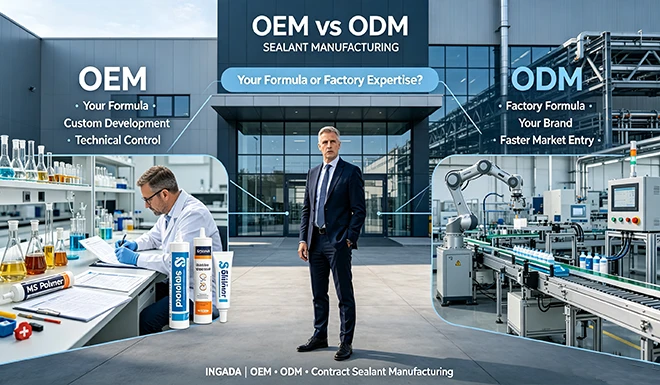
When companies decide to launch their own sealant brand, expand their product portfolio, or source construction adhesives from overseas manufacturers, one strategic question usually comes first:
Should we develop our own formula through OEM sealant manufacturing, or use a factory’s mature technology through ODM manufacturing?
Choosing the wrong manufacturing model can lead to:
- Longer product development cycles
- Higher technical investment
- Increased quality risks
- Delayed market entry
For distributors, importers, construction material brands, and industrial suppliers, understanding OEM vs ODM sealant manufacturing is critical before selecting a long-term manufacturing partner.
This guide explains the differences between:
- OEM Sealant Manufacturing — Bring Your Own Formula
- ODM Sealant Manufacturing — Factory Formula + Your Brand
- Custom Label Sealant Manufacturing — Ready-to-Market Private Brand Solutions
1. What Is OEM Sealant Manufacturing?
OEM (Original Equipment Manufacturing): Your Formula, Factory Production
OEM manufacturing means the buyer provides the product concept, technical requirements, or existing formulation, while the manufacturer produces the sealant according to agreed specifications.
In an OEM relationship:
The buyer controls the product technology.
The manufacturer mainly provides:
- Manufacturing capability
- Production equipment
- Quality control
- Packaging process
- Scale-up production support
The buyer usually provides:
- Formula requirements
- Performance targets
- Raw material specifications
- Application requirements
- Market positioning
Typical OEM Sealant Manufacturing Process
| Stage | Buyer Responsibility | Manufacturer Responsibility |
|---|---|---|
| Formula Development | Define technical requirements | Evaluate production feasibility |
| Testing | Approve performance targets | Laboratory testing |
| Sample Approval | Confirm final specification | Produce samples |
| Mass Production | Product acceptance | Manufacturing & QC |
| Packaging | Brand requirements | Filling & labeling |
When Should You Choose OEM Sealant Manufacturing?
OEM is suitable for companies that already have:
1. Proprietary Technology
Examples:
- Unique curing system
- Special adhesion performance
- Customized chemical formulation
- Specific industrial application requirements
For example, an engineering company may require a sealant designed specifically for:
- Structural bonding
- Extreme temperature environments
- Special substrates
2. Strong Technical Capability
OEM works best when buyers have:
- Internal R&D teams
- Technical engineers
- Product testing capability
- Clear performance specifications
Without technical resources, OEM projects may become slower and more expensive.
2. What Is ODM Sealant Manufacturing?
ODM (Original Design Manufacturing): Factory Technology + Your Brand
ODM manufacturing allows buyers to use an existing, tested sealant formulation developed by the manufacturer.
Instead of creating a formula from zero, buyers select a mature product platform and customize:
- Brand name
- Packaging design
- Product appearance
- Color options
- Label information
- Technical documents
This model is widely used in:
- Construction materials
- Adhesive distribution
- Hardware retail
- Private label products
Why Do Global Buyers Choose ODM?
1. Faster Market Entry
Developing a new sealant formula requires:
- Laboratory testing
- Raw material evaluation
- Performance verification
- Field application validation
ODM reduces these steps because the manufacturer already has a mature product system.
2. Lower Technical Risk
A professional ODM manufacturer normally provides:
- Existing formulation experience
- Production know-how
- Quality control procedures
- Application recommendations
For companies entering the sealant market for the first time, ODM can significantly reduce development risk.
3. Build Your Own Brand Without Your Own Factory
Through custom label sealant manufacturing, companies can create:
- Their own brand identity
- Their own packaging
- Their own product portfolio
without investing in:
- Chemical production facilities
- Laboratory infrastructure
- Manufacturing equipment
OEM vs ODM Sealant Manufacturing Comparison
| Factor | OEM Sealant Manufacturing | ODM Sealant Manufacturing |
|---|---|---|
| Formula Ownership | Buyer controlled | Manufacturer developed |
| Development Time | Longer | Faster |
| Initial Investment | Higher | Lower |
| Technical Requirement | High | Medium |
| Product Customization | Very High | Medium |
| Market Launch Speed | Slow | Fast |
| Suitable Customers | Established brands | New brands & distributors |
| Risk Level | Higher | Lower |
3. Decision Framework: OEM or ODM?
Before choosing a manufacturing model, buyers should answer five questions.
Question 1: Do You Own a Formula?
Yes → Consider OEM
If you already have:
- Formula ownership
- Technical documents
- Performance specifications
OEM may be the correct choice.
No → Consider ODM
If you mainly need:
- Reliable product
- Your own brand
- Faster launch
ODM is usually more practical.
Question 2: How Fast Do You Need Market Entry?
Fast Launch Strategy → ODM
Many distributors prefer ODM because they can quickly develop:
- Sealant product range
- Packaging system
- Sales materials
and start market testing.
Long-Term Technology Strategy → OEM
Companies planning long-term differentiation may prefer OEM because they control product development.
Question 3: What Type of Customer Are You?
| Customer Type | Recommended Model |
|---|---|
| Large chemical brand | OEM |
| Regional distributor | ODM |
| Construction material importer | ODM |
| Engineering company | OEM |
| New private brand | ODM |
| Retail chain | Custom Label ODM |
4. Contract Sealant Manufacturing: A Flexible Solution
Between OEM and ODM, many companies choose:
Contract Sealant Manufacturing
This model provides flexibility by combining:
- Manufacturer production capability
- Formula adjustment
- Packaging customization
- Brand development support
A contract sealant manufacturing partner can help with:
- Product selection
- Formula modification
- Packaging design
- Export documentation
- Quality management
This approach is especially suitable for:
- Overseas distributors
- Building material companies
- Construction suppliers
- Regional brands
5. What Should Buyers Evaluate Before Choosing a Sealant Manufacturer?
Selecting a manufacturing partner requires more than comparing prices.
A professional buyer should evaluate:
1. Product Technology Capability
A qualified manufacturer should understand:
- MS Polymer Sealant technology
- Silicone Sealant technology
- Construction Sealant applications
- Industrial bonding requirements
INGADA focuses on Silane-Modified Polymer (MS Polymer) technology and provides multiple adhesive and sealant product series for construction and industrial applications.
2. Product Portfolio
A strong supplier should support different market segments:
| Application | Product Category |
|---|---|
| Curtain Wall | Structural Silicone Sealant |
| Building Facade | Weatherproof Sealant |
| Flooring | Acoustic Flooring Adhesive |
| Bathroom | Anti-Mold Sealant |
| Industrial Assembly | MS Polymer Adhesive |
INGADA’s product portfolio covers MS adhesive series, anti-mold sealants, weatherproof sealants, flooring adhesives, and silicone sealant series.
3. Quality & Compliance Support
International buyers should check:
- Technical Data Sheet (TDS)
- Safety Data Sheet (SDS)
- Testing reports
- Regional compliance requirements
INGADA product references include compliance categories such as REACH, RoHS, CE, ASTM and other certifications depending on the specific product series.
OEM vs ODM Selection Matrix
| Business Situation | Recommended Model |
|---|---|
| You already own formula | OEM |
| You need exclusive technology | OEM |
| You are launching a new brand | ODM |
| You need private label products | ODM |
| You want faster market testing | ODM |
| You want production outsourcing | Contract Manufacturing |
6. Common Mistakes When Choosing a Sealant Manufacturing Model
Mistake 1: Choosing Only Based on Price
Low-cost suppliers may not provide:
- Stable quality
- Technical support
- Consistent production
A reliable manufacturing partner should create long-term supply value.
Mistake 2: Choosing OEM Without Technical Resources
OEM requires detailed technical communication.
Without:
- Formula knowledge
- Testing standards
- Engineering requirements
ODM may be the better solution.
Mistake 3: Ignoring Future Product Expansion
A good manufacturing partner should support future growth:
- Additional sealant products
- New applications
- Market expansion
FAQ: OEM vs ODM Sealant Manufacturing
What is the difference between OEM and ODM sealant manufacturing?
OEM means the buyer provides or controls the formula, while ODM means the manufacturer provides a mature formula that can be customized with the buyer’s brand.
Is ODM sealant lower quality than OEM?
No. ODM products can use professionally developed formulas that have already been tested and optimized for specific applications.
What is custom label sealant?
Custom label sealant means a manufacturer produces sealant products under the buyer’s own brand name and packaging.
Which manufacturing model is better for a new sealant brand?
For most new brands, ODM or custom label sealant manufacturing provides faster market entry with lower technical risk.
Can ODM sealant products be customized?
Yes. Buyers can usually customize packaging, branding, colors, product positioning, and documentation depending on the manufacturer’s capability.
Conclusion: Choose the Right Manufacturing Strategy
The choice between OEM vs ODM sealant manufacturing depends on your business goals.
Choose OEM when:
- You own technology
- You require unique formulation
- Product differentiation is critical
Choose ODM when:
- You want faster market entry
- You need proven technology
- You want your own branded sealant products
For many international distributors and construction material companies, ODM + custom label sealant manufacturing provides the best balance between speed, flexibility, and investment efficiency.
Partner With INGADA
INGADA provides professional OEM, ODM, and contract sealant manufacturing solutions for global customers.
Our capabilities include:
- MS Polymer Sealant
- Silicone Sealant
- Construction Adhesive
- Private Label Manufacturing
- Custom Sealant Solutions
Contact INGADA technical team: hua@ingadabondpro.com
Discover more from INGADA The Ultimate Bonding Expert
Subscribe to get the latest posts sent to your email.