One Component vs Two Component Sealants: Which Fits Your Production Line?

Introduction: Sealant Selection Is a Production Decision
For industrial manufacturers, choosing a sealant is not only a question of adhesion, flexibility, or chemical resistance.
It is also a production-line decision.
A sealant that performs well in laboratory testing may still be inefficient if it:
- cures too slowly,
- requires excessive fixture time,
- limits line speed,
- needs manual mixing,
- creates material waste,
- or cannot integrate with automated dispensing equipment.
This is why industrial buyers increasingly compare 1K vs 2K sealants based on the entire production process rather than material price alone.
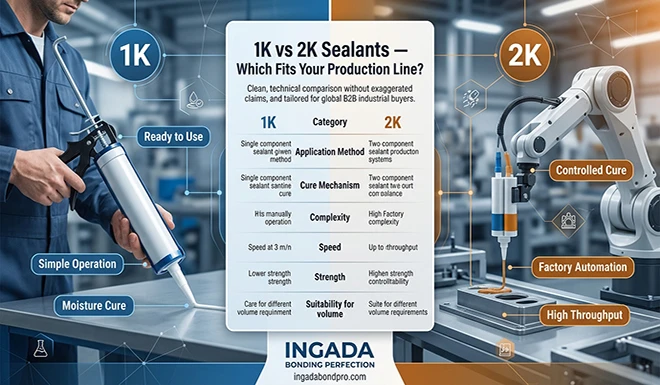
In simple terms:1K sealants prioritize simplicity and convenience, while 2K sealants prioritize controlled reaction speed and production throughput.
The right choice depends on your substrate, joint design, required handling time, production volume, equipment, and automation strategy.
What Is a One-Component Sealant?
A one-component sealant, commonly called a 1K sealant, is supplied as a ready-to-use formulation.
The material does not require the operator to mix a separate curing component before application.
Common 1K technologies include:
- One-component polyurethane sealant
- One-component silicone sealant
- One-component MS Polymer sealant
For buyers who want to understand the chemistry, performance advantages, and industrial applications of MS Polymer technology in greater detail, see our What Is MS Polymer Sealant? Complete Guide for Industrial Buyers.
Many 1K systems cure after application through a reaction with moisture in the surrounding environment.
This makes 1K sealants particularly attractive for:
- Construction installation
- Repair work
- Low-to-medium production volumes
- On-site applications
- Applications where simple operation is more important than maximum line speed
Why Manufacturers Choose 1K Sealants
The biggest advantage of 1K technology is operational simplicity.
The operator can:
- Load the cartridge or sausage
- Dispense the sealant
- Tool the joint
- Allow the product to cure
There is no separate A/B component ratio to control during application.
That reduces:
- Mixing equipment requirements
- Operator training
- Mixing-ratio errors
- Cleaning requirements
For example, INGADA MS-55 is listed as a single-component structural adhesive, with a full cure of 48–72 hours for a 6 mm bead.
This illustrates the fundamental 1K trade-off:
Simple application, but cure speed can become the production bottleneck.
What Is a Two-Component Sealant?
A two-component sealant, or 2K sealant, consists of two separate components, usually called:
- Component A
- Component B
The components remain separated during storage.
They are combined immediately before or during dispensing.
Once mixed, the chemical reaction starts and the sealant cures independently of atmospheric moisture.
This makes 2K technology particularly attractive for controlled factory environments.
A typical automated 2K system consists of:
A Component + B Component → Metering → Mixing → Dispensing → Cure
The mixing ratio must remain within the manufacturer’s specified tolerance.
1K vs 2K: The Fundamental Difference
| Factor | 1K Sealant | 2K Sealant |
|---|---|---|
| Components | One | Two |
| Preparation | Ready to use | Requires metering/mixing |
| Curing trigger | Usually moisture or ambient conditions | Chemical reaction after mixing |
| Operation | Simple | More controlled |
| Equipment | Lower complexity | Metering/mixing equipment required |
| Production speed | Can be limited by cure rate | Generally better suited to high-throughput processes |
| Automation | Suitable for many dispensing operations | Highly suitable for automated production |
| Mixing error | None during application | Must control A:B ratio |
| Cleaning | Generally simpler | Mixing equipment requires management |
| Best fit | Flexible production and installation | High-volume factory production |
1K vs 2K Sealant Curing Rate: What the Data Actually Means
This is one of the most misunderstood areas of sealant selection.
A 1K curing rate and a 2K snap time are not the same measurement.
A 1K moisture-cure sealant may be reported as: 3.5 mm / 24 hours
while a 2K silicone may be reported as: Snap time: 35–50 minutes
These numbers cannot simply be compared as “35 minutes is faster than 24 hours.”
They describe different stages of the curing process.
Example: One-Component PU Sealant
A published technical data sheet for Sika’s one-component polyurethane sealant Sikaflex PRO-3 reports:
- Skinning time: approximately 60 minutes
- Curing rate: approximately 3.5 mm / 24 hours
- Conditions: 23°C / 50% RH
This illustrates the typical moisture-cure limitation of 1K polyurethane:
The deeper the sealant joint, the longer the center of the bead may require to cure.
Example: One-Component Silicone
A published Sika technical document for Sikasil SG-15 reports:
- Skin time: 15 minutes
- Tack-free time: 25 minutes
- Curing speed: approximately 1/8 inch in 24 hours
Again, the important point is that the material develops a skin relatively quickly, but full cure progresses inward from the exposed surface.
Example: Two-Component Silicone
A 2K silicone behaves differently.
For example, Sika’s Sikasil SG-502 is a two-component structural silicone with a reported:
- Snap time: approximately 35 minutes
- Tack-free time: approximately 100 minutes
The manufacturer specifies that curing starts immediately after mixing and that reaction speed depends strongly on temperature.
Another 2K silicone, Sikasil SG-500, reports approximately:
- Snap time: 50 minutes
- Tack-free time: 240 minutes
These examples demonstrate why 2K systems can provide much more controlled cure initiation throughout the mixed material, rather than relying primarily on moisture diffusion from the surface.
The Production-Line Question: Cure Speed or Handling Speed?
For factory buyers, the more important question is often not: “How fast does the sealant fully cure?”
but: “How quickly can the next production step begin?”
This distinction matters.
A production line may only require sufficient initial strength for:
- removing a fixture,
- moving a component,
- transferring a panel,
- packaging a product,
- starting the next assembly operation.
Therefore, purchasing decisions should consider:
1. Skin Time
How long before the surface forms a skin?
2. Tack-Free Time
How long before the surface is no longer tacky?
3. Snap Time
For certain 2K systems, how long before the mixed material reaches a defined initial cure state?
4. Handling Time
When can the bonded/sealed assembly safely move to the next operation?
5. Full Cure
When does the sealant reach its specified final mechanical properties?
This broader shift toward performance-balanced adhesive technologies is also driving the adoption of hybrid sealants in industrial procurement. See Hybrid Sealant vs. Traditional Sealant: The Evolution of Industrial Adhesives for a deeper look at
Why 2K Sealants Are Attractive for Factory Automation
High-volume manufacturing creates a different set of priorities from construction-site application.
A factory may need to produce:
- hundreds of windows,
- thousands of panels,
- insulating glass units,
- automotive components,
- industrial assemblies,
within a fixed production cycle.
In this environment, curing speed becomes a major productivity factor.
2K systems can offer four production advantages.
1. Controlled Cure Initiation
Because the reaction starts after A and B are mixed, the manufacturer can design the dispensing process around a predictable curing reaction.
2. Reduced Dependence on Ambient Humidity
A moisture-cure 1K sealant depends partly on environmental conditions.
Temperature and relative humidity can influence curing.
A 2K system generates its curing reaction through the mixed components, making the process less dependent on atmospheric moisture.
3. High-Volume Dispensing
2K systems can be integrated with:
- Metering pumps
- Static mixers
- Dynamic mixers
- Robotic dispensing systems
- Automated assembly lines
4. Better Fit for Continuous Production
When the production cycle is tightly controlled, reducing cure-related waiting time can increase equipment utilization and reduce work-in-process inventory.
Where 1K Sealants Still Make More Sense
It would be a mistake to conclude that 2K is always better.
For many manufacturers, 1K remains the more economical and practical solution.
Choose 1K when:
- Production volume is moderate
- Operators need a simple dispensing process
- Equipment investment must remain low
- Components are assembled in small batches
- Long cure time does not affect production throughput
- Field installation is part of the application
- The product needs long working time
- Multiple colors or formulations are frequently changed
The operational simplicity of 1K can outweigh its slower cure rate.
One-Component Polyurethane: Where Does It Fit?
Single-component polyurethane sealant remains widely used for:
- Construction joints
- Expansion joints
- Concrete sealing
- Infrastructure
- General industrial sealing
Its major advantages include:
- Strong adhesion
- Elasticity
- Good mechanical properties
- Ready-to-use application
However, one-component PU is moisture-cured, so curing speed depends on joint depth and environmental conditions.
For factory applications with thick beads or strict cycle-time requirements, this curing mechanism should be evaluated carefully.
Two-Part Silicone Sealant: Where Does It Fit?
Two-part silicone sealant is particularly relevant when manufacturers need:
- High production throughput
- Controlled curing
- Automated dispensing
- Structural bonding
- Consistent factory conditions
When selecting between silicone and MS Polymer for a specific application, curing technology is only one part of the decision. Buyers should also evaluate adhesion, weather resistance, paintability, movement capability, and substrate compatibility. See MS Polymer vs. Silicon for a detailed comparison.
2K silicone is widely used in demanding applications such as:
- Structural glazing
- Insulating glass
- Window bonding
- Industrial assembly
In glass curtain wall and structural glazing applications, sealant selection and joint design are critical not only for bonding performance but also for preventing water penetration. Learn more in How Sealants Protect Glass Curtain Walls from Water Leakage.
This makes two-part silicone an important option for factories where cure control and production speed are more important than the simplicity of a ready-to-use 1K product.
1K vs 2K for Automated Production
The choice becomes clearer when production automation is considered.
| Production Requirement | 1K | 2K |
|---|---|---|
| Manual dispensing | Excellent | Good |
| Cartridge application | Excellent | Possible |
| Robotic dispensing | Excellent | Excellent |
| High-volume production | Good | Excellent |
| Short cycle time | Limited by product | Strong advantage |
| No mixing equipment | Excellent | No |
| Consistent A:B ratio | N/A | Requires equipment control |
| Rapid fixture release | Product dependent | Often favorable |
| Simple SKU change | Excellent | More complex |
| Low capital investment | Excellent | Lower suitability |
How to Calculate the Real Production Impact
Industrial buyers should not compare sealant prices alone.
Instead, calculate:
Total Production Cost = Material + Labor + Equipment + Cure Time + WIP + Rework
For example, suppose a factory applies 2,000 assemblies per day.
If each assembly must remain in a fixture for an additional 30 minutes because of slow cure, the resulting work-in-process inventory can become substantial.
A faster-curing 2K system may therefore have a higher price per kilogram but a lower cost per finished assembly.
This is why procurement teams should evaluate: Cost per finished unit — not simply cost per cartridge or kilogram.
INGADA 1K MS Polymer: Where Convenience Meets Industrial Performance
INGADA’s product portfolio is strongly focused on Silane Modified Polymer (MS Polymer) technology.
The catalog describes MS Polymer as combining advantages associated with silicone and polyurethane while offering paintability, zero migration, solvent-free formulation, primerless adhesion and high elasticity.
Several INGADA 1K MS Polymer products demonstrate different curing and handling profiles.
MS-10 Construction Adhesive
- Skin time: ≤45 minutes
- Elongation: ≥350%
- Tensile strength: ≥1.6 MPa
- Solvent-free
- Paintable and sandable
MS-35 Instant Grab Construction Adhesive
- Initial time: ≤15 seconds
- Initial grab: up to 800 kg/m²
- Shear strength: up to 3.2 MPa
- Zero-sag
- Paintable
MS-55 Structural Adhesive
- Single component
- Shear strength: ≥3.7 MPa
- Full cure: 48–72 hours at 6 mm
- Service temperature: -40°C to 90°C
These products show an important point:
1K does not automatically mean “slow at every stage.”
A 1K formulation can have fast initial grab or skin formation while still requiring substantially longer time to achieve full cure.
A Practical Decision Matrix for Production Managers
| Your Production Situation | Better Starting Point |
|---|---|
| Small-batch manufacturing | 1K |
| Manual assembly | 1K |
| On-site installation | 1K |
| Frequent product changes | 1K |
| Low equipment investment | 1K |
| High-volume production | 2K |
| Automated dispensing | 2K |
| Short fixture time | 2K |
| Controlled factory environment | 2K |
| Structural glazing production | 2K silicone |
| Flexible general-purpose bonding | 1K MS Polymer |
| Need simple operator training | 1K |
1K vs 2K Sealant: The Five Questions Procurement Teams Should Ask
Before choosing a sealant system, ask the supplier:
1. What is the skin time?
This determines how quickly the surface becomes resistant to handling.
2. What is the curing rate?
For 1K moisture-cure systems, ask for curing depth in mm/24 h under specified temperature and humidity.
3. What is the snap or tack-free time?
For 2K systems, ask which test method and environmental conditions were used.
4. What is the fixture-release time?
This is often more relevant to factory productivity than full cure time.
5. What happens when production temperature changes?
Cure speed can change significantly with temperature, humidity, bead geometry and mixing conditions.
Supplier TDS data should therefore always be reviewed under the actual production conditions.
Common Mistakes When Choosing Between 1K and 2K
Mistake 1: Choosing Based Only on Price per Kilogram
A cheaper sealant can become more expensive if it creates:
- Longer fixture times
- More labor
- Larger WIP inventory
- Slower production
Mistake 2: Comparing Skin Time With Full Cure
A sealant can become tack-free quickly while remaining uncured internally.
Always distinguish:
Skin Time ≠ Handling Time ≠ Full Cure
Mistake 3: Assuming 2K Always Means Faster
2K technology is often advantageous for controlled, high-throughput production, but actual cure and handling performance remains product-specific.
Therefore: Buy the process performance, not simply the “2K” label.
Mistake 4: Ignoring Equipment Compatibility
A 2K sealant requires the correct:
- Metering ratio
- Pump capacity
- Mixing system
- Static/dynamic mixer
- Dispensing pressure
- Cleaning procedure
An incorrect setup can cause:
- Poor mixing
- Inconsistent cure
- Material waste
- Bond failure
Final Verdict: Which Sealant Fits Your Production Line?
There is no universal winner between 1K and 2K sealants.
The decision depends on production economics.
Choose 1K when your priority is:
Convenience + flexibility + low equipment complexity
1K is particularly suitable for:
- General construction
- Manual assembly
- Repair
- Medium-volume manufacturing
- Flexible production schedules
Choose 2K when your priority is:
Throughput + controlled curing + factory automation
2K is particularly suitable for:
- High-volume production
- Automated dispensing
- Structural glazing
- Industrial assembly
- Processes where fixture time limits line speed
The Bottom Line
For industrial buyers, the best sealant is not necessarily the one with the fastest laboratory cure.
It is the one that creates the lowest total production cost while meeting the required technical performance.
Before selecting between a single-component polyurethane, 1K MS Polymer, or two-part silicone sealant, evaluate the complete production cycle:
Dispensing → Open Time → Skin/Snap Time → Fixture Release → Handling → Full Cure → Next Process
That is the correct way to determine whether 1K or 2K sealant technology fits your production line.
FAQ
What is the difference between 1K and 2K sealant?
1K sealants are supplied as one ready-to-use component and typically cure through moisture or another ambient trigger. 2K sealants contain separate components that are mixed immediately before application and begin curing through a chemical reaction after mixing.
Is 2K sealant always faster than 1K?
No. 2K systems are often better suited to controlled, high-throughput production because curing starts after mixing, but actual snap time, tack-free time and full cure depend on the formulation and production conditions.
Is one-component polyurethane a 1K sealant?
Yes. A single-component polyurethane sealant is commonly classified as a 1K PU sealant.
What is a two-part silicone sealant?
A two-part silicone sealant is a 2K silicone system consisting of separate A and B components. After controlled mixing, the material cures through a chemical reaction. Such systems are widely used for demanding industrial and structural glazing applications.
Which is better for factory automation, 1K or 2K?
For high-volume automated production, 2K can offer significant process advantages because curing begins after mixing and the system can be integrated with metering and automated dispensing equipment. However, 1K can also work very well in automated dispensing when its cure profile fits the production cycle.
Does INGADA offer 1K MS Polymer sealants?
Yes. INGADA’s product portfolio includes multiple MS Polymer adhesive products, including MS-10, MS-20, MS-35, MS-35H and MS-55. The catalog identifies MS-55 as a single-component structural adhesive.
Request a Sealant Recommendation for Your Production Line
If you are evaluating 1K vs 2K sealants for a new production line or looking to reduce fixture time, provide your supplier with:
- Substrate materials
- Joint or bead dimensions
- Required production cycle time
- Current sealant type
- Target cure/handling time
- Dispensing equipment
- Production temperature and humidity
INGADA can provide product TDS documentation and application recommendations for industrial buyers evaluating MS Polymer and other sealant technologies.
INGADA — Bonding Perfection
Email: hua@ingadabondpro.com
Website: ingadabondpro.com
Discover more from INGADA The Ultimate Bonding Expert
Subscribe to get the latest posts sent to your email.
Discover more from INGADA The Ultimate Bonding Expert
Subscribe to get the latest posts sent to your email.