What Is MS Polymer Sealant? Complete Guide for Industrial Buyers

Why Industrial Buyers Are Moving Beyond Traditional PU Sealants
For decades, polyurethane (PU) sealants have been widely used in construction joints, industrial assembly and bonding applications because of their strong adhesion and mechanical performance.
However, global industrial buyers are increasingly facing several challenges:
- PU sealants contain isocyanate chemistry, raising environmental and workplace safety concerns.
- Traditional PU products may suffer from UV aging when exposed outdoors.
- Many PU systems require primers, increasing labor cost and installation complexity.
- Silicone sealants provide excellent weather resistance but usually cannot be painted and may create migration risks on sensitive substrates.
This has accelerated the adoption of MS polymer sealant, a next-generation hybrid technology based on Silane Modified Polymer (SMP).
MS polymer sealant combines the flexibility and weather resistance of silicone with the bonding strength of polyurethane while eliminating many limitations of traditional systems.
What Is MS Polymer Sealant?
Definition of MS Polymer Sealant
MS Polymer Sealant is a moisture-curing hybrid sealant based on Silane Modified Polymer (SMP) technology.
Unlike conventional PU sealants, MS polymer does not rely on isocyanate groups for curing. Instead, it uses silane-functionalized polymer chains that react with atmospheric moisture to form a flexible, durable sealing network.
The result is a single-component sealant with:
- High elasticity
- Strong adhesion
- Excellent weather resistance
- Paint compatibility
- Low VOC characteristics
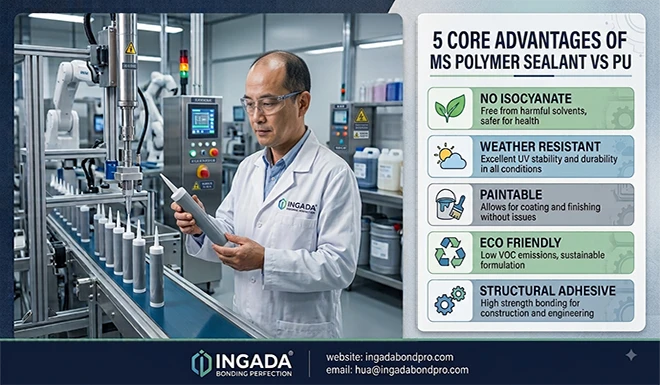
MS Polymer Sealant vs PU Sealant: 5 Core Advantages for Industrial Buyers
1. No Isocyanate — Safer Chemical Profile
One of the biggest advantages of MS polymer sealant is its isocyanate-free formulation.
Traditional PU sealants depend on isocyanate chemistry, which can create concerns during manufacturing, handling and application.
MS polymer technology provides:
| Feature | PU Sealant | MS Polymer Sealant |
|---|---|---|
| Isocyanate content | Commonly used | No isocyanate |
| Odor level | Medium | Low odor |
| Workplace exposure concerns | Higher | Reduced |
| Environmental positioning | Traditional | More eco-oriented |
For distributors and contractors serving green building markets, MS polymer offers a cleaner alternative.
2. Superior Weather Resistance for Outdoor Applications
Outdoor construction materials face:
- UV radiation
- Temperature cycling
- Rain and humidity
- Freeze-thaw movement
Traditional PU sealants may degrade faster under continuous UV exposure.
MS polymer sealants provide improved outdoor durability because of their hybrid polymer structure.
Typical applications include:
- Curtain walls
- Expansion joints
- Prefabricated buildings
- Infrastructure sealing
INGADA MS weatherproof MS polymer series covers movement classes from ±25% to ±50%, including high-movement structural applications.
3. Paintable Surface — Better Finishing Flexibility
A major limitation of silicone sealants is poor paint adhesion.
MS polymer sealants solve this problem.
After curing, many MS sealants can be painted with common architectural coatings, making them suitable for:
- Interior decoration
- Wall panels
- Doors and windows
- Prefabricated construction
This reduces the visual limitation of traditional silicone systems.
4. Eco-Friendly and Low VOC Technology
Modern construction projects increasingly require:
- Low VOC materials
- Green building compliance
- Improved indoor air quality
MS polymer sealants typically provide:
- Solvent-free formulations
- Low odor performance
- Low migration characteristics
INGADA MS Polymer products are positioned as solvent-free, primerless adhesion solutions with eco-certified characteristics.
5. Structural Adhesive Performance
Unlike traditional sealing-only materials, MS polymer technology can provide both:
- Sealing function
- Structural bonding capability
This makes it suitable for:
- Metal bonding
- Panel installation
- Flooring systems
- Heavy-duty assembly
For example, INGADA MS-55 Structural Adhesive provides:
| Parameter | Performance |
|---|---|
| Shear strength | ≥3.7 MPa |
| Hardness | Shore A 70±5 |
| Application | Metal bonding, concrete & stone assembly |
| Compliance | REACH, CE, ASTM, ISO 11600 |
MS Polymer vs PU vs Silicone Sealant Comparison Matrix
| Performance Factor | MS Polymer Sealant | PU Sealant | Silicone Sealant |
|---|---|---|---|
| Chemical Technology | Silane Modified Polymer | Polyurethane | Silicone |
| Isocyanate Free | ✅ Yes | ❌ No | Usually Yes |
| UV Resistance | Excellent | Medium | Excellent |
| Paintable | ✅ Yes | Limited | ❌ No |
| Primer Requirement | Often unnecessary | Often required | Application dependent |
| Elastic Recovery | Excellent | Good | Excellent |
| Structural Bonding | Excellent | Good | Medium |
| Migration Risk | Low | Medium | Possible |
| Green Building Compatibility | High | Medium | Medium |
Engineering Performance Logic: Why MS Polymer Works Better
Dynamic Joint Movement
Buildings continuously expand and contract because of:
- Temperature changes
- Wind load
- Structural vibration
- Seismic movement
A rigid adhesive may crack.
MS polymer maintains flexibility while keeping strong adhesion.
Example:
INGADA MS-635 Expansion Joint Sealant:
| Parameter | Value |
|---|---|
| Movement Capability | ±35% |
| Elongation | ≥600% |
| UV Stability | 3,000 hours |
| Fatigue Testing | 5,000 cycles |
Common Industrial Applications of MS Polymer Sealant
Construction & Building Envelope
Applications:
- Curtain walls
- Facades
- Expansion joints
- Prefabricated structures
Recommended:
- MS-625
- MS-635
- MS-650
Interior Installation
Applications:
- Wall panels
- Decorative materials
- Metal bonding
- Flooring installation
Recommended:
- MS-35
- MS-35H
- MS-55
INGADA MS adhesive series includes products designed for wall panels, flooring, vibration environments and structural installation.
How to Choose MS Polymer Sealant for Industrial Projects?
Industrial buyers should evaluate:
| Selection Factor | Question |
|---|---|
| Movement capability | How much joint movement is expected? |
| Substrate compatibility | Concrete, metal, glass, stone or plastic? |
| Weather exposure | Indoor or outdoor? |
| Painting requirement | Must the sealant be painted? |
| Compliance | REACH, RoHS, ASTM, VOC requirements? |
FAQ: MS Polymer Sealant Questions from Industrial Buyers
Is MS polymer sealant better than PU sealant?
For many construction and industrial applications, yes. MS polymer provides similar bonding strength while offering advantages such as no isocyanate chemistry, better UV stability and paintability.
Can MS polymer sealant replace silicone?
In many applications, yes.
MS polymer is especially suitable where buyers need:
- Paintability
- Strong adhesion
- Low migration
- Structural bonding
However, silicone may still be preferred for certain extreme-temperature or specialized glazing applications.
Is MS polymer sealant environmentally friendly?
MS polymer technology is generally considered a more environmentally oriented solution because many formulations are solvent-free, low odor and free from isocyanate chemistry.
Does MS polymer require primer?
Many MS polymer sealants provide primerless adhesion on common construction substrates, reducing installation steps and labor cost.
Why Global Buyers Choose INGADA MS Polymer Solutions
INGADA develops Silane Modified Polymer technology for international construction and industrial markets.
Key advantages include:
- Multiple MS adhesive and weatherproof sealant series
- ISO 9001 quality management system
- Compliance support including REACH, RoHS, French VOC A+, FDA and ASTM-related standards depending on product category
- Export experience across 50+ countries
Request MS Polymer Sealant Technical Documents & Samples
For distributors, contractors and industrial buyers evaluating MS polymer sealant solutions:
Contact INGADA technical engineering team to request:
- TDS documents
- Compliance certificates
- Product samples
- Application recommendations
Contact:
Email: hua@ingadabondpro.com
Discover more from INGADA The Ultimate Bonding Expert
Subscribe to get the latest posts sent to your email.