China Sealant Manufacturer vs. European Brand: Cost, Quality & Lead Time

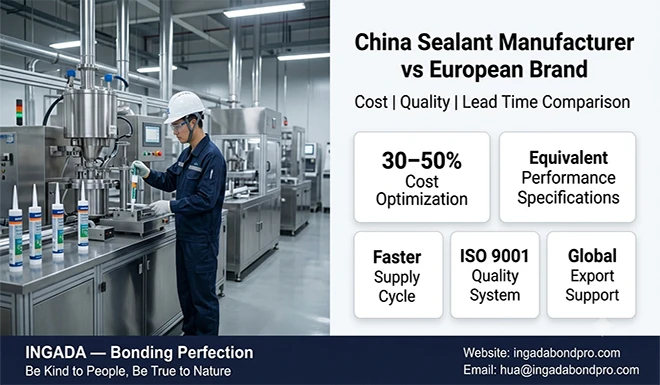
How Procurement Buyers Can Reduce Sealant Costs by 30–50% Without Sacrificing Performance
European sealant brands have built strong global recognition through decades of engineering experience and project references. However, their final selling price includes more than the formulation itself.
For global construction companies, distributors, and industrial procurement teams, choosing between a China sealant manufacturer vs. European brand is no longer simply a question of price.
The real question is:
Can a Chinese sealant supplier deliver equivalent technical performance, compliance, and supply reliability while significantly reducing total material costs?
In many cases, the answer is yes. Modern Chinese manufacturers specializing in MS Polymer, silicone, polyurethane, and hybrid sealant technologies have invested heavily in polymer research, automated production, laboratory testing, and international certification.
The result is a new sourcing model:
The result is a new sourcing model:Replace high-cost imported sealants with technically equivalent products while achieving 30–50% raw material cost reduction
For procurement managers evaluating alternatives to established European brands such as Sika, the decision should not be based only on brand reputation. A complete evaluation should include:
- Supply chain flexibility
- Chemical formulation
- Mechanical performance
- Certification compliance
- Total landed cost
- Lead time
1. Why Are European Sealants More Expensive?
The cost of imported sealants usually contains several additional layers:
| Cost Component | European Brand Impact | Chinese Manufacturer Advantage |
|---|---|---|
| Raw polymer materials | High | Optimized sourcing |
| Brand premium | Significant | Lower marketing overhead |
| Regional distribution layers | Multiple margins | Direct factory supply |
| Warehouse costs | Higher | Factory-direct logistics |
| Import inventory risk | Higher | Flexible production planning |
| OEM customization | Limited | Available |
For large-volume buyers, these additional costs can create a substantial price gap.
According to INGADA supply data, comparable sealant categories can achieve:
| Product Category | European Brand Price Range | INGADA FOB Range |
|---|---|---|
| Weatherproof Silicone Sealant | EUR 5–8/unit | USD 1.5–5/unit |
| MS Polymer Sealant | EUR 5–8/unit | USD 1.5–4/unit |
| PU Construction Sealant | EUR 4.5–10/unit | USD 1.45–3.5/unit |
| Structural Silicone | EUR 8–15/unit | USD 3–7/unit |
This pricing difference creates an opportunity for procurement teams to optimize material budgets without automatically reducing product performance.
2. The 30–50% Cost Reduction Strategy: Buy Performance, Not Brand Names
A common mistake in industrial purchasing is comparing products only by manufacturer name.
A more effective approach is to compare:
Performance Specification → Application Requirement → Equivalent Product
For example:
A façade contractor does not actually require a famous logo on the cartridge. They require:
- Movement capability
- UV resistance
- Adhesion strength
- Weather durability
- Compliance documentation
If these specifications are equivalent, the procurement decision can shift from brand-based purchasing to engineering-based sourcing.
Example: Replacing Premium Imported MS Sealant
Many European MS Polymer products are positioned as premium hybrid solutions.
A qualified Chinese MS Polymer manufacturer can provide similar technical characteristics:
| Performance Requirement | Required Specification | INGADA MS Polymer Solution |
|---|---|---|
| Elasticity | High movement absorption | Up to ≥600% elongation |
| VOC | Low emission requirement | Solvent-free formulation |
| Adhesion | Primerless bonding | Multi-substrate adhesion |
| Paintability | Required for construction | Paintable surface |
| Environmental compliance | International markets | REACH / RoHS / French VOC A+ options |
INGADA’s MS Polymer technology combines advantages of silicone and polyurethane:
- Silicone advantage:
- UV resistance
- Weather durability
- Polyurethane advantage:
- Strong adhesion
- Structural performance
- MS Polymer advantage:
- Paintable
- Zero migration
- Solvent-free
- Primerless application
3. Chinese Sealant Supplier vs European Brands: What Really Matters?
The comparison should not be:
China = cheap / Europe = quality
The modern industrial supply chain is more complex.
The correct comparison is:
Factory Capability + Quality System + Technical Support + Supply Reliability
Key Evaluation Factors
1. Polymer Technology
A capable manufacturer should control:
- Polymer modification
- Rheology adjustment
- Curing system
- Adhesion promoter technology
- Aging resistance testing
INGADA operates with:
- Postdoctoral Research Station
- 3 PhD polymer scientists
- National Technical Center
and manufactures 7 product series with 41 SKUs covering:
- MS Adhesives
- Weatherproof Sealants
- Anti-Mold Sealants
- Flooring Adhesives
- PU Foam
- Structural Silicone
- Silicone Weatherproof Sealants
2. Quality Management System
International buyers should verify:
- ISO 9001 quality system
- Batch traceability
- COA documentation
- TDS availability
- ASTM testing where applicable
INGADA maintains ISO 9001 quality management and provides compliance documentation including selected:
- REACH
- RoHS
- French VOC A+
- FDA
- ASTM-related standards
4. Why Procurement Teams Are Considering a Sika Alternative
Sika AG has established a strong reputation in construction chemicals, especially in:
- Structural bonding
- Waterproofing
- Construction sealants
- Industrial applications
However, many buyers are now exploring a Sika alternative because of:
- Increasing material costs
- Distributor markups
- Longer supply chains
- Regional price differences
A practical replacement evaluation should compare:
| Category | Evaluation Question |
|---|---|
| Chemistry | Is the polymer system equivalent? |
| Certification | Does it meet project requirements? |
| Performance | Are ASTM/mechanical values comparable? |
| Application | Does it solve the same engineering problem? |
| Supply | Can delivery be guaranteed? |
The goal is not simply finding a cheaper product.
The goal is:
Achieving equivalent engineering performance with a more efficient supply chain.
Technical Comparison Matrix: China Sealant Manufacturer vs. European Brand
5. Technical Comparison: Equivalent Performance, Different Supply Economics
When evaluating a Chinese sealant supplier vs European brands, professional procurement teams should move away from a simple price comparison.
The correct approach is a weighted technical evaluation model.
A sealant should be selected according to:
- Application requirement
- Required movement capability
- Adhesion strength
- Weather resistance
- Compliance requirements
- Total procurement cost
Weighted Scoring Matrix: Sealant Supplier Evaluation
The following model helps procurement teams compare suppliers objectively.
| Evaluation Factor | Weight | European Premium Brand | Qualified Chinese Manufacturer | Procurement Consideration |
|---|---|---|---|---|
| Technical Performance | 30% | 9/10 | 8–9/10 | Compare TDS data, not brand name |
| Certification Compliance | 20% | 9/10 | 8–9/10 | Verify project-specific standards |
| Raw Material Cost | 20% | 5/10 | 9/10 | Direct factory sourcing advantage |
| Lead Time | 15% | 6/10 | 8–9/10 | Production flexibility matters |
| OEM / Customization | 10% | 5/10 | 9/10 | Private label opportunities |
| Technical Support | 5% | 8/10 | 8–9/10 | Direct engineer communication |
Key conclusion:
A qualified Chinese manufacturer can achieve similar technical scores while creating significant cost advantages.
6. Performance Comparison: MS Polymer vs Traditional Sealant Systems
Modern construction buyers increasingly evaluate MS Polymer sealant as an alternative to conventional silicone and polyurethane products.
Chemistry Comparison
| Technology | Advantages | Limitations |
|---|---|---|
| Silicone Sealant | Excellent UV resistance, weather durability | Limited paintability, possible migration issues |
| Polyurethane Sealant | Strong adhesion, structural capability | Contains isocyanates, lower UV resistance |
| MS Polymer Sealant | Paintable, elastic, solvent-free, primerless adhesion | Higher material cost than basic silicone |
Why MS Polymer Helps Reduce Total Project Cost
Although MS Polymer may have a slightly higher material cost than standard silicone, the total installed cost can be reduced because it can eliminate:
- Primer application
- Additional surface preparation
- Rework caused by staining
- Paint compatibility issues
The procurement calculation should therefore consider:
Total Installed Cost = Material Cost + Labor Cost + Risk Cost
Not only:
Cartridge Price × Quantity
7. ASTM & International Specification Alignment
For international construction projects, procurement buyers should evaluate whether a sealant matches required engineering specifications.
Common Sealant Specification Hierarchy
| Requirement Level | Buyer Question | Verification Method |
|---|---|---|
| Chemical System | Is the formulation suitable? | Product technical sheet |
| Mechanical Performance | Does it meet strength requirements? | Tensile / elongation data |
| Movement Capability | Can it absorb structural movement? | ASTM movement class |
| Environmental Safety | Is it suitable for target markets? | REACH / RoHS / VOC documents |
| Project Approval | Is documentation available? | TDS / COA / certification |
8. Example: High-Movement Facade Sealant Alternative
For curtain walls, infrastructure, and expansion joints, the critical factor is not brand origin.
It is movement capability.
INGADA MS Weatherproof Sealant Series provides solutions covering:
- ±25% movement
- ±35% movement
- ±50% movement
including:
MS-625 Low-Modulus Polyether Sealant
Application:
- Precast structures
- Prefabricated buildings
- Expansion joints
Technical characteristics:
| Property | Value |
|---|---|
| Movement Class | ±25% |
| Tensile Modulus | 0.4 MPa |
| UV Resistance | 3,000 hours |
| Maximum Joint Width | Up to 50mm |
MS-635 Ultra-Low Modulus Expansion Joint Sealant
Designed for:
- Curtain walls
- Bridges
- Tunnels
- Seismic zones
Technical characteristics:
| Property | Value |
|---|---|
| Movement Class | ±35% |
| Elongation | ≥600% |
| Fatigue Testing | 5,000 cycles |
| UV Stability | 3,000 hours |
MS-650 High-Movement Joint Sealant
For demanding environments:
- Super-tall buildings
- Seismic zones
- Long-span structures
Technical characteristics:
| Property | Value |
|---|---|
| Movement Class | ±50% |
| Elongation | ≥780% |
| Service Temperature | -40°C to 90°C |
9. Lead Time Comparison: Imported Sealants vs Direct Factory Supply
Cost reduction is only valuable when supply remains stable.
Many procurement teams underestimate inventory cost caused by long international supply chains.
Lead Time Comparison
| Supply Stage | European Brand Model | Chinese Factory Direct Model |
|---|---|---|
| Production | 4–6 weeks | In-stock 2–3 days / Custom 2–3 weeks |
| Sea Freight | 25–35 days | 20–25 days |
| Total Delivery Cycle | 8–12 weeks | 4–6 weeks |
| Emergency Supply | Limited flexibility | Expedited options available |
10. Supply Chain Advantages of Working With a Chinese Sealant Manufacturer
For distributors and contractors, direct factory cooperation can provide additional advantages:
Safety Stock Programs
A reliable manufacturer can support:
- Reserved inventory
- Priority production allocation
- Emergency replenishment
INGADA provides:
- 1–2 months reserved inventory upon contract agreement
- Emergency replenishment green lane
- Regional hub solutions where applicable
OEM and Private Label Opportunities
European brands often focus on standardized products.
Chinese manufacturers usually provide more flexibility:
- Custom packaging
- Distributor branding
- Market-specific labels
- Regional product adaptation
INGADA supports:
- OEM private label production within 4–6 weeks
- Multi-language label support
- Exclusive distribution cooperation
11. Procurement Checklist: How to Qualify a Chinese Sealant Supplier
Before replacing a European brand, buyers should verify:
Technical Evaluation
☑ Product TDS available
☑ Mechanical data provided
☑ Aging test information available
☑ Application compatibility confirmed
Quality Evaluation
☑ ISO 9001 system
☑ Batch traceability
☑ COA documentation
☑ Sample testing completed
Commercial Evaluation
☑ FOB pricing comparison
☑ MOQ requirements
☑ Delivery schedule
☑ Payment terms
Market Compliance
☑ REACH
☑ RoHS
☑ VOC requirements
☑ ASTM requirements where applicable
Key Takeaway for Global Procurement Buyers
A successful transition from a European sealant brand to a Chinese manufacturer does not depend on choosing the lowest-priced cartridge.
It depends on selecting a supplier that can provide:
Equivalent performance + verified compliance + shorter supply chain + lower total cost
For many applications, a qualified Chinese sealant manufacturer can help procurement teams achieve:
30–50% raw material cost reduction while maintaining required engineering specifications.
12. Frequently Asked Questions
FAQ 1: Can a Chinese sealant manufacturer replace European brands?
Yes, for many construction and industrial applications, a qualified Chinese sealant manufacturer can replace European brands when the technical specifications match the project requirements.
Procurement teams should compare:
- Polymer technology
- Tensile strength
- Elongation
- Movement capability
- UV resistance
- Certification requirements
- Total installed cost
The decision should be based on engineering performance rather than country of origin.
FAQ 2: How can buyers reduce sealant costs by 30–50%?
rocurement buyers can reduce sealant costs by combining three strategies:
1. Direct Factory Purchasing
Removing multiple distribution layers can significantly reduce product cost.
2. Specification-Based Sourcing
Instead of purchasing based on brand preference, compare:
- ASTM requirements
- ISO standards
- Application performance
- Required durability
3. Supply Chain Optimization
Reducing:
- Import inventory cost
- Emergency purchasing
- Long replenishment cycles
can improve total procurement efficiency.
A qualified Chinese supplier can often provide equivalent technical solutions with lower manufacturing and supply-chain costs.
FAQ 3: Is a Chinese sealant supplier lower quality than European brands?
Not necessarily.
Quality depends on:
- Manufacturing process
- Raw material control
- Laboratory capability
- Quality management system
- Technical support
Modern Chinese manufacturers serving international markets increasingly operate under global quality systems.
INGADA operates under ISO 9001 quality management and provides selected products meeting international requirements including:
- REACH
- RoHS
- French VOC A+
- FDA
- ASTM-related standards
FAQ 4: What is the best Sika alternative for construction sealants?
The best alternative depends on the application.
For façade and expansion joints:
Recommended evaluation criteria:
- Movement class
- Weather resistance
- Low modulus performance
- Adhesion strength
For interior bonding:
Evaluate:
- Initial grab
- Paintability
- VOC level
- Surface compatibility
For wet areas:
Evaluate:
- Anti-mold performance
- Water resistance
- Long-term elasticity
INGADA provides multiple sealant technologies including:
- MS Polymer
- Weatherproof sealants
- Anti-mold sealants
- Structural silicone
- PU sealants
covering different engineering requirements.
FAQ 5: What should importers check before buying sealants from China?
Before placing an order, buyers should request:
Technical Documents
- TDS
- SDS
- COA
- Test reports
Product Validation
- Sample testing
- Compatibility testing
- Application trials
Supplier Verification
- Factory capability
- Quality system
- Export experience
- Production capacity
INGADA has exported products to more than 50 countries and serves international customers including Fortune 500 companies.
13. Conclusion: The Future of Sealant Procurement
The global sealant market is moving from brand-driven purchasing toward performance-driven sourcing.
For procurement managers, distributors, and contractors, the key question is no longer:
“Is this product made in Europe or China?”
The better question is:
“Can this supplier deliver the required performance, compliance, and supply reliability at a more competitive total cost?”
A professional Chinese sealant manufacturer can provide:
✓ Equivalent technical specifications
✓ International compliance support
✓ Faster supply cycles
✓ OEM flexibility
✓ 30–50% cost optimization opportunities
For companies evaluating alternatives to imported sealants, factory-direct sourcing from China has become a practical supply-chain strategy.
Discover more from INGADA The Ultimate Bonding Expert
Subscribe to get the latest posts sent to your email.