Sika vs. Dow vs. Chinese Sealant Manufacturers: B2B Sourcing Analysis

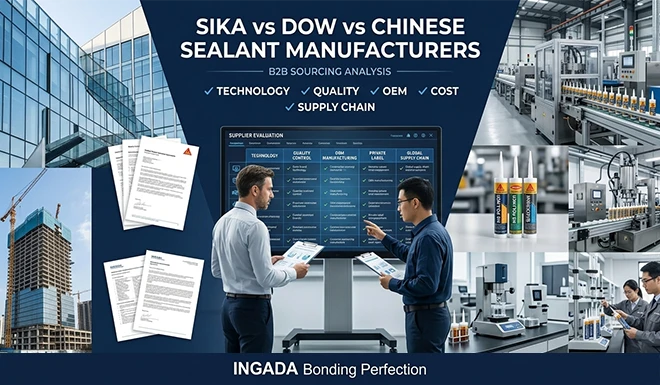
For international distributors, construction companies, contractors and private-label brands, selecting a sealant supplier is not simply a purchasing decision.
It is a strategic decision involving:
- Product technology
- Quality consistency
- Supply chain reliability
- Market competitiveness
- Long-term business growth
When sourcing construction materials, global buyers usually compare three supplier models:
- International chemical brands such as Sika and Dow
- Regional sealant manufacturers
- Chinese sealant manufacturers with OEM capabilities
Each supplier model has different advantages. The best choice depends on:
- Target market requirements
- Engineering specifications
- Certification expectations
- Distribution strategy
- Customization requirements
1. Why Buyers Compare Sika, Dow and Chinese Sealant Manufacturers
The construction materials industry has changed significantly.
International brands have traditionally dominated premium construction projects because of strong brand recognition, engineering reputation and established distribution networks.
Companies such as Sika and Dow have built strong positions in:
- Construction Chemicals
- Silicone Sealant solutions
- Structural Silicone Sealant systems
- Industrial bonding technologies
However, more global buyers are now evaluating Chinese sealant manufacturers because of:
- Rising material costs
- Distributor margin pressure
- Demand for OEM Manufacturing
- Private Label Manufacturing opportunities
- Flexible Global Supply Chain solutions
2. Understanding Three Different Sealant Supplier Models
Before comparing Sika, Dow and Chinese sealant manufacturers, international buyers should understand that these suppliers represent different business models.
Model 1: International Chemical Brands
Global companies such as Sika and Dow have established strong positions in construction chemicals, Silicone Sealant technologies and industrial material solutions.
Their main advantages include:
- Strong global brand recognition
- Established engineering reputation
- International technical documentation
- Large project references
- Mature distribution networks
International brands are often selected for:
- Large infrastructure projects
- International contractors
- High-profile architectural projects
- Specification-driven applications
However, global brands may have limitations for distributors and private-label businesses:
- Higher purchasing cost
- Limited product customization
- Strict channel management
- Less flexibility for OEM requirements
Model 2: Regional Sealant Manufacturers
Regional manufacturers may provide competitive pricing and local market support. However, their capabilities vary significantly.
Professional buyers should verify:
- Production ownership
- Technical development capability
- Quality management systems
- Export experience
Model 3: Chinese Sealant Manufacturers
Professional Chinese sealant manufacturers have developed rapidly and now provide solutions across multiple product categories.
A qualified Chinese manufacturer can support:
- MS Polymer Sealant
- Silicone Sealant
- Construction Sealant
- Structural Silicone Sealant
- Anti-Mold Sealant
- Flooring Adhesive
- OEM Manufacturing
- Private Label Manufacturing
3. Supplier Comparison: Sika vs. Dow vs. Chinese Sealant Manufacturers
| Factor | Sika / Dow | Chinese Sealant Manufacturer |
|---|---|---|
| Brand Recognition | Very Strong | Growing International Recognition |
| Engineering Reputation | Excellent | Depends on Manufacturer Capability |
| Product Range | Extensive | Extensive |
| OEM Manufacturing | Limited | Strong |
| Private Label Manufacturing | Limited | Strong |
| MOQ Flexibility | Lower | Higher |
| Customized Packaging | Limited | Flexible |
| Cost Advantage | Moderate | Strong |
| Direct Factory Communication | Limited | Available |
Dow Silicone Technology in Sealant Applications
Dow is widely recognized for advanced silicone chemistry and material science solutions used in construction, industrial and specialty applications.
In professional sealant sourcing decisions, buyers often compare silicone-based technologies from global chemical companies such as Dow with alternative solutions including MS Polymer Sealant and Silicone Sealant products from qualified Chinese manufacturers.
Understanding the relationship between silicone technology, application requirements and supplier capability helps buyers select the right Construction Sealant solution for their market.
4. Technology Comparison: Silicone Sealant vs MS Polymer Sealant
For professional buyers, supplier evaluation should start from application requirements and sealant technology.
The two major technologies widely considered in construction and industrial applications are:
- Silicone Sealant
- MS Polymer Sealant
Understanding Building Sealant Applications
Building Sealant is an essential construction material used for joint sealing, waterproofing, weather protection and long-term building performance.
Professional Building Sealant solutions are commonly applied in:
- Building facades
- Windows and doors
- Curtain wall systems
- Expansion joints
- General construction projects
When sourcing Building Sealant from China, buyers should evaluate product technology, substrate compatibility, durability and manufacturer capability.
Silicone Sealant Technology
Silicone Sealant has been widely used for exterior applications because of excellent weather resistance and long-term durability.
Typical applications include:
- Glass curtain walls
- Facade sealing
- Weatherproof joints
- Structural glazing systems
Advantages
- Excellent UV resistance
- Outstanding weather durability
- Wide temperature resistance
- Long service life
Limitations
- Limited paintability
- Some substrate compatibility challenges
- Application restrictions in specific bonding situations
MS Polymer Sealant Technology
MS Polymer Sealant has become increasingly popular among construction contractors, distributors and industrial users.
It combines flexibility, adhesion performance and environmental advantages.
Advantages
- Excellent elastic recovery
- Strong substrate adhesion
- Paintable after curing
- Low odor characteristics
- Suitable for bonding and sealing
Technology Comparison Table
| Performance | Silicone Sealant | MS Polymer Sealant |
|---|---|---|
| Weather Resistance | Excellent | Excellent |
| UV Resistance | Excellent | Very Good |
| Paintability | Limited | Excellent |
| Elastic Bonding | Good | Excellent |
| Indoor Application | Good | Excellent |
5. Quality Control Comparison
Quality consistency is one of the most important factors when comparing international sealant brands and Chinese sealant manufacturers.
For B2B buyers, supplier evaluation should focus on manufacturing systems rather than simply country of origin.
International Brand Quality System
Global companies such as Sika and Dow usually maintain:
- International R&D systems
- Standardized testing procedures
- Global quality management systems
- Extensive technical databases
- Long-term engineering experience
Chinese Manufacturer Quality System
Professional Chinese sealant manufacturers can establish competitive quality systems through:
- Raw material inspection
- Production process control
- Laboratory testing
- Batch traceability
- Finished product inspection
- Continuous improvement systems
The key difference is not geographic location.
The key difference is: Professional manufacturer vs. unqualified supplier.
Buyer Quality Verification Checklist
| Evaluation Item | Why It Matters |
|---|---|
| Factory Information | Verify real manufacturing capability |
| Technical Data Sheet (TDS) | Understand product performance |
| Safety Data Sheet (SDS) | Confirm chemical safety information |
| Test Reports | Evaluate application performance |
| Production Process | Confirm quality consistency |
6. Certification and Compliance Analysis
International buyers need reliable documentation when importing Construction Sealant and other building materials.
Certifications and standards help buyers evaluate product suitability for different markets.
| Standard | Application |
|---|---|
| ASTM C920 | Elastomeric Joint Sealants |
| ASTM C1184 | Structural Silicone Sealants |
| ISO 11600 | Building Construction Sealants |
| REACH | Chemical Compliance Requirements |
| VOC Requirements | Indoor Environmental Performance |
Professional Chinese sealant manufacturers can support international customers through:
- Technical documentation
- Product testing support
- Market-specific compliance documents
- OEM documentation packages
7. Cost Structure Analysis
The difference between global brands and Chinese manufacturers is often not only product technology.
It is also the business model behind the supply chain.
International Brand Cost Structure
Pricing usually includes:
- Brand value
- Global marketing investment
- Distribution network costs
- Technical service systems
- Corporate operating costs
Chinese Manufacturer Cost Advantage
Professional Chinese manufacturers benefit from:
- Integrated chemical supply chains
- Large-scale production efficiency
- Flexible packaging solutions
- Direct factory sourcing
- OEM Manufacturing capability
| Factor | Global Brand | Chinese Manufacturer |
|---|---|---|
| Product Price | Higher | Competitive |
| Customization | Limited | Strong |
| MOQ Flexibility | Lower | Higher |
| Distributor Margin Potential | Moderate | Higher |
| Private Label Opportunity | Limited | Strong |
China Sealant Manufacturing and Global Supply Chain Advantages
China has become an important part of the global supply chain for construction materials, including sealants, adhesives and related chemical products.
Professional Chinese sealant manufacturers benefit from integrated raw material networks, mature production systems, packaging capabilities and international logistics infrastructure.
For global buyers, direct cooperation with qualified manufacturers can provide advantages in:
- OEM Manufacturing
- Private Label Manufacturing
- Customized product solutions
- Flexible supply strategies
- Long-term cooperation models
When selecting a Chinese sealant manufacturer, buyers should evaluate manufacturing capability, technical support and supply stability rather than focusing only on price.
8. OEM Manufacturing and Private Label Manufacturing Opportunities
Many international distributors are moving from traditional product purchasing toward strategic manufacturing partnerships.
Instead of only selling existing brands, companies increasingly develop their own sealant brands through OEM Manufacturing and Private Label Manufacturing.
Traditional Distribution Model
International Brandr → Regional Distributor → Local Dealer → End Customer
Challenges:
- Limited brand ownership
- Lower margin control
- Less product flexibility
Private Label Manufacturing Model
Chinese Sealant Manufacturer → Your Brand → Your Distribution Network → Your Customers
Advantages:
- Brand ownership
- Higher customization capability
- Better market differentiation
- Long-term business development
OEM Manufacturing Support May Include:
- Product selection
- Formula adjustment
- Packaging customization
- Technical documents
- Application support
- Market adaptation
9. What Professional Sealant Buyers Should Verify Before Cooperation
Based on international sealant sourcing requirements, professional buyers usually evaluate five key areas before selecting a manufacturing partner.
| Evaluation Area | Buyer Verification |
|---|---|
| Factory Capability | Production equipment, manufacturing capacity and quality management systems |
| Technical Capability | TDS, SDS, testing data and application knowledge |
| Product Performance | Adhesion, durability, movement capability and substrate compatibility |
| Compliance Support | Standards, certifications and export documentation |
| Long-Term Supply Stability | Production consistency, delivery ability and cooperation model |
A professional sealant supplier should not only provide products. The supplier should provide a complete solution including technical support, documentation and reliable supply capability.
10. INGADA: Chinese Sealant Manufacturer Supporting Global Markets
About Beijing INGADA Technology Development Co., Ltd.
Beijing INGADA Technology Development Co., Ltd. (INGADA) is a professional Chinese sealant manufacturer specializing in construction and industrial adhesive solutions.
The company focuses on developing and manufacturing high-performance sealing and bonding products for international distributors, contractors, engineers and private-label brands.
INGADA product solutions include:
- MS Polymer Sealant
- Silicone Sealant
- Construction Sealant
- Structural Silicone Sealant
- Anti-Mold Sealant
- Flooring Adhesive
INGADA Manufacturing and OEM Capability
Through OEM Manufacturing and Private Label Manufacturing services, INGADA supports global customers with customized product solutions.
- Product selection support
- Customized packaging
- Technical documentation
- Application recommendations
- Long-term supply cooperation
Serving Global Construction Material Markets
INGADA works with international customers looking for reliable Chinese manufacturing partners within the global supply chain of Construction Materials.
11. FAQ: Sika vs. Dow vs. Chinese Sealant Manufacturers
Q1: Are Chinese sealant manufacturers comparable to Sika and Dow?
Professional Chinese sealant manufacturers can provide competitive solutions through advanced production systems, quality control processes, technical documentation and OEM Manufacturing capability. However, buyers should evaluate each manufacturer individually.
Q2: Why do companies still choose Sika or Dow sealants?
Global brands provide strong advantages in brand recognition, engineering acceptance, international project experience and established technical systems.
Q3: Why do distributors choose Chinese sealant manufacturers?
Distributors often choose Chinese manufacturers because of competitive pricing, flexible MOQ, OEM Manufacturing options, Private Label Manufacturing capability and direct factory communication.
Q4: Can Chinese manufacturers produce high-quality MS Polymer Sealant and Silicone Sealant?
Quality depends on manufacturing capability, formulation technology, raw materials, testing procedures and quality management systems rather than geographic location alone.
Q5: Which supplier model is better for my business?
| Business Goal | Recommended Supplier Model |
|---|---|
| Large engineering projects | International brands or premium manufacturers |
| Regional distribution | Professional Chinese sealant manufacturer |
| Private brand development | OEM Manufacturing partner |
| Cost optimization | Direct factory sourcing |
Q6: How should buyers evaluate a Chinese sealant manufacturer?
Professional buyers should evaluate factory capability, technical documents, product performance, compliance support and long-term supply stability before selecting a Chinese sealant manufacturer.
12. Final Conclusion: Choosing the Right Sealant Supply Partner
The comparison between Sika, Dow and Chinese sealant manufacturers is not simply about deciding which supplier is better.
It is about selecting the supplier model that matches your business strategy.
International brands provide:
- Strong brand recognition
- Engineering confidence
- Established market reputation
Professional Chinese sealant manufacturers provide:
- Flexible manufacturing solutions
- Competitive supply chain advantages
- OEM Manufacturing opportunities
- Private Label Manufacturing solutions
- Direct factory cooperation
For global distributors, contractors and brand owners, the ideal supplier is not only a product provider. It is a long-term manufacturing partner supporting business growth.
Request Sealant Sourcing Support
INGADA supports international buyers with:
- MS Polymer Sealant solutions
- Silicone Sealant products
- Construction Sealant applications
- OEM Manufacturing
- Private Label Manufacturing
- Technical documentation support
Contact INGADA to discuss your sealant sourcing requirements and explore long-term cooperation opportunities.
Discover more from INGADA The Ultimate Bonding Expert
Subscribe to get the latest posts sent to your email.