Supertall Curtain Wall Sealant Solutions: Scaling New Heights at Dubai’s Ciel Tower

Introduction:
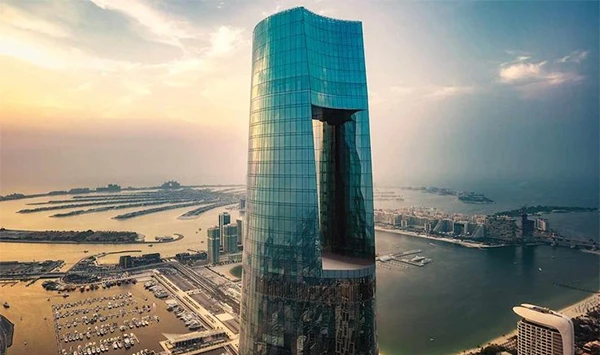
Dubai’s Ciel Tower, engineered by China Railway 18th Bureau Group, stands at an unprecedented 373.5 meters, breaking the world record for the tallest standalone hotel. Achieving a rapid “one floor every three days” fast-track construction cycle, this megastructure has become the new landmark of Dubai Marina. However, supertall high-rises under accelerated timelines face extreme engineering challenges. Managing structural displacement under intense wind loads and high-altitude desert heat requires an elite commercial building facade sealant. Traditional PU or standard silicones frequently fail under these conditions, making advanced MS Polymer technology essential for long-term structural integrity.
As a key supplier of architectural sealants to China Railway 18th Bureau Group, INGADA successfully weathered the demanding test of this landmark project.
Need to Overcome Difficulties
High-Altitude Wind Loads & Seismic Displacement: At heights exceeding 370 meters, building facades experience extreme negative wind pressure and thermal movement. Substandard joints suffer cohesive failure, leading to water infiltration and structural vulnerability.
Extreme Desert Climate & UV Degradation: Dubai’s summer surface temperatures routinely exceed 50°C. Intense solar radiation accelerates joint aging, causing traditional sealants to harden, crack, and lose elasticity.
Aggressive Fast-Track Construction Schedules: The “one floor every three days” window leaves zero margin for slow-curing materials. Delaying facade sealing risks cascading bottlenecks across the entire building enclosure timeline.
Technical Parameter Comparison
The table below highlights why engineering directors specify high-movement joint sealants over legacy formulations:
| Technical Metrics | Traditional PU / Silicone Sealants | INGADA MS-650 (Supertall Enclosure Grade) |
| Movement Capacity | ±25% | ±50% (Class 50 per ASTM C920) |
| Service Temperature Range | -20°C to 70°C | -40°C to 90°C (Desert Thermal Shock Resistant) |
| Modulus Type | High/Medium Modulus | Low Modulus (Low stress on aluminum/glass bonds) |
| Slump/Sag Resistance | < 3mm | 0mm (Excellent thixotropy for vertical joints) |
| Environmental Compliance | High VOC / Contains Solvents | Solvent-free, Isocyanate-free, French A+ Certified |
The Engineering Solution: INGADA MS-650
For iconic supertall architectural projects like the Ciel Tower, INGADA MS-650 High-Movement Joint Sealant delivers the definitive weatherproof sealant for high-rise buildings.
Engineered with cutting-edge silane-modified polymer (MS Polymer) technology, INGADA MS-650 features an extraordinary ±50% dynamic movement capability (Class 50). This low-modulus formulation absorbs immense structural stresses without delaminating from sensitive aluminum extrusions or double-glazed curtain wall units. Offering superior UV stability and primerless adhesion to diverse architectural substrates, it perfectly aligns with high-speed overseas construction cadences.

Regulatory Compliance & Sustainability
INGADA MS-650 complies with international engineering benchmarks, including GB/T 14683-2017 and global seismic design regulations. It carries the China Green Building Product Certification and the prestigious French A+ Indoor Air Quality Rating. Free of solvents and hazardous VOCs, it satisfies the strict environmental mandates required for premium LEED-certified developments across the Middle East and global B2B supply chains.
Technical FAQ
Q1: Why is a low-modulus sealant critical for structural curtain wall joint design?
- A1: Low-modulus sealants exert minimal stress on the adhesion interface during thermal expansion and contraction, preventing delamination from aluminum panels and fragile glass substrates under heavy wind-load cycles.
Q2: How does MS Polymer technology perform under extreme UV exposure?
- A2: Unlike polyurethane, INGADA MS-650 features a back-bone polymer structure that does not yellow, chalk, or crack under intense UV radiation, maintaining elastomeric performance from -40°C up to 90°C.
Q3: How does this sealant accelerate fast-track building construction?
- A3: It offers excellent non-sag thixotropy for rapid gunning and eliminates the need for primers on most porous and non-porous substrates, shortening application times and safeguarding project handovers.
#FacadeEngineering #CurtainWallSealant #MSPolymer #SupertallConstruction #ConstructionProcurement #CielTower #INGADABond
Discover more from INGADA The Ultimate Bonding Expert
Subscribe to get the latest posts sent to your email.