Facade Sealant Compatibility: What to Check Across Glass, Aluminium and Stone

Quick Answer
“Compatible” is used as if it were one property. On a facade it is three, and they fail in different ways:
- Chemical compatibility — the sealant must not stain, soften or discolour the substrate, or react with adjacent materials.
- Adhesion — it must actually bond to the specific finish, not to the generic material name.
- Mechanical compatibility — its movement capability must match the differential movement of the two substrates it joins.
For the wider detail set across facade systems, see facade and glazing solutions.
A product can pass one and fail the other two. That is why a datasheet cannot answer the question, and why a site adhesion test is not bureaucracy — it is the only evidence that covers all three at once.
1. Each Substrate Has Its Own Governing Issue
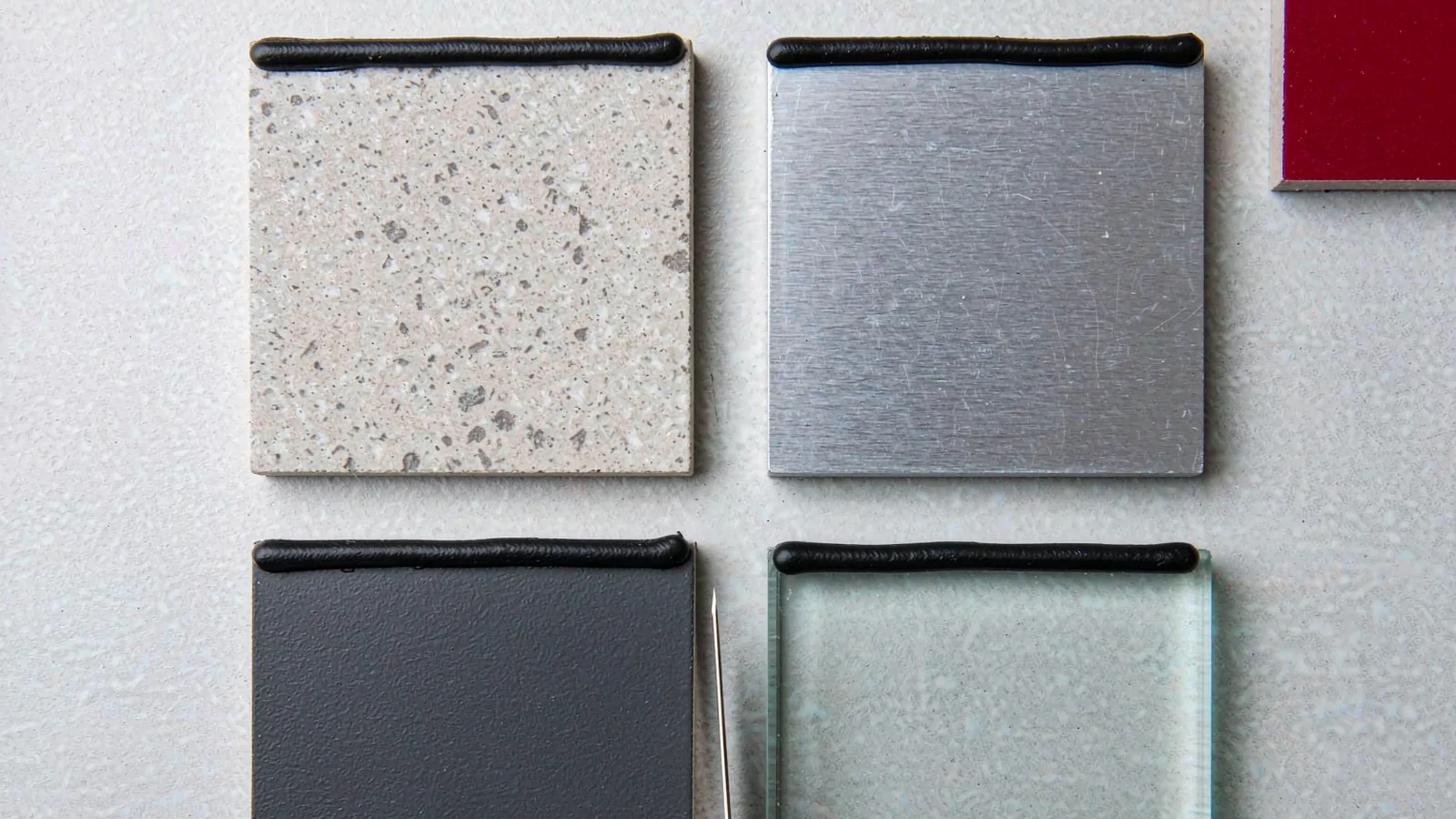
| Substrate | What decides success | Failure if ignored |
|---|---|---|
| Glass | Adhesion to a non-porous, smooth surface; compatibility with setting blocks and gaskets | Adhesion loss along the bond line |
| Coated aluminium, PVDF, powder coat | The coating, not the metal | Peeling from the finish; staining on light colours |
| Concrete, ALC, fibre cement | Porosity and alkalinity; moisture migration | Slow adhesion loss, often after a season |
| Natural stone (limestone, marble, travertine) | Oil and plasticiser migration | Irreversible staining — the most expensive failure in this category |
Note the asymmetry: three of these can be repaired. Stone staining cannot. A coloured halo in a marble facade is a replacement job, not a maintenance item.
2. Natural Stone: “No Staining” Is a Hard Requirement
Natural stone is porous and capillary-active. Any oil, plasticiser or unreacted component that migrates into the surface leaves a dark, permanent mark that no cleaning will remove.
Two consequences for specification:
- Ask for the no-staining declaration per model, not per range. A formulation without oil-based plasticiser is the usual way to achieve it, and it is stated model by model in a good TDS.
- Do not extrapolate. Stone-safe is a property of the specific formulation; a sibling grade in the same series may not carry it.
In the INGADA range the stone-facade grade is MS-635, whose TDS explicitly declares no staining on natural stone and lists stone facade joints as an application. For stone combined with metal or glass — a mixed facade — SR-35 is the alternative: ±35% displacement with an oil-free formulation that the TDS describes as preventing substrate staining.
The joint schedule that sits around these compatibility questions — substrate pairs, movement classes, documents — is in the building envelope sealant specification checklist.
Where the stone is being fixed rather than sealed — brackets, back-bolt zones — this is a structural application with different requirements entirely, and the sealant discussion does not apply.
3. Coated Metal: Test the Finish, Not the Metal
Metal facades are coated, and the coating is what the sealant touches. Anodised aluminium, polyester powder coat, PVDF and plastisol each present a different surface energy, and adhesion differs accordingly.
Two tests belong before any large-scale application:
- Compatibility test — confirm the sealant does not react with the coating, or with existing sealant already in the joint.
- Adhesion test — confirm bond strength on the actual coated panel, with a primer if the TDS requires one.
The reason this is not optional: the same product can perform well on anodised aluminium and poorly on a chalky powder coat, and there is no visual difference at the time of application. A trial area that is inspected after full cure is the only reliable check.
Add one more for light-coloured coatings: ask whether the formulation is tested for plasticiser migration. A bead that leaves a dark outline on a white panel has failed commercially even if it is still adhering.
4. Silicate Substrates: MS Polymer, and Always Test
Concrete, mortar, ALC block and fibre cement are porous and alkaline. Silicone sealants can bond initially and lose adhesion over time, particularly where moisture migrates through the wall.
The systematic answer in this range is an MS polymer — for example MS-625, a low-modulus polyether at ±25% displacement with concrete adhesion ≥1.2 MPa, and a paintable surface if the joint will be decorated.
Even with the right chemistry, a site adhesion test is mandatory on silicate substrates before large-scale work. The substrate varies too much — age, surface carbonation, release agents, dust — for a laboratory figure to be conclusive.
5. Glass: Compatibility Includes the Accessories
For glass-to-metal facade joints, the sealant itself is usually straightforward. The compatibility questions sit around it:
- Setting blocks and gaskets — EPDM, silicone and neoprene behave differently in contact with uncured sealant.
- Structural vs weather application — a weather joint between glass and frame is a movement detail; a structural bond is a load path and needs project approval. The distinction is set out in structural silicone vs weatherproofing sealant.
- Adjacent sealants in the same joint — where an existing bead is being overlaid, compatibility testing covers both materials, not just the substrate.
6. How to Run an Adhesion Test That Means Something
The field test is simple, but only if it is done the same way each time:
- Prepare the surface as the specification requires — clean, dry, primer if specified.
- Apply a bead to the actual substrate, tooled to a realistic thickness.
- Cure fully — a peel test on a semi-cured bead tells you nothing about service performance.
- Cut and pull — slice along both sides of a 100 mm section and pull at roughly 90°, slowly.
- Record the failure mode, not just pass or fail: cohesive (the sealant itself tears), adhesive (it lifts cleanly from the substrate), or mixed. Adhesive failure means the surface preparation or the product is wrong; cohesive failure means the bond is stronger than the sealant.
- Photograph it and file it with the batch number and the location.
A facade contractor who keeps these records has a defensible position two years later. One who does not is relying on the sealant’s reputation.
7. A Compatibility Register Worth Keeping
| Field | Content |
|---|---|
| Substrate pair | e.g. PVDF aluminium to marble |
| Sealant model and batch | Exact code, production batch |
| Surface preparation | Cleaner used, primer, interval |
| Test date and cure time | Before the pull test |
| Result and failure mode | Cohesive / adhesive / mixed, with percentage estimate |
| Adjacent materials | Gaskets, blocks, existing sealant |
| Staining check | On a spare panel, after full cure |
| Approved by | Name and date |
Discuss Your Facade Compatibility Requirement with INGADA
If you are specifying a sealant across several facade substrates, send the substrate list with finishes, the joint details and the movement calculation. We will confirm which models carry a no-staining declaration, which require a primer, and where a site adhesion test is the only way to close the question.
Compatibility and adhesion must be confirmed on the actual substrate and finish. Product data describes the sealant; it cannot describe your project’s surface.