Hybrid Sealant vs. Traditional Sealant: The Evolution of Industrial Ad

The Industrial Adhesive Market Is Entering a New Era
For decades, industrial buyers have mainly selected between two traditional technologies:
- Polyurethane (PU) sealants for strong adhesion and mechanical performance
- Silicone sealants for weather resistance and long-term flexibility
Both technologies have played important roles in construction, automotive, manufacturing and infrastructure.
However, modern
Industrial buyers today are looking for materials that provide:
- Strong bonding performance
- Long-term outdoor durability
- Lower environmental impact
- Easier installation
- Compatibility with multiple substrates
- Compliance with international regulations
This demand has accelerated the adoption of hybrid sealants, especiallyMS Polymer (Silane Modified Polymer) technology.
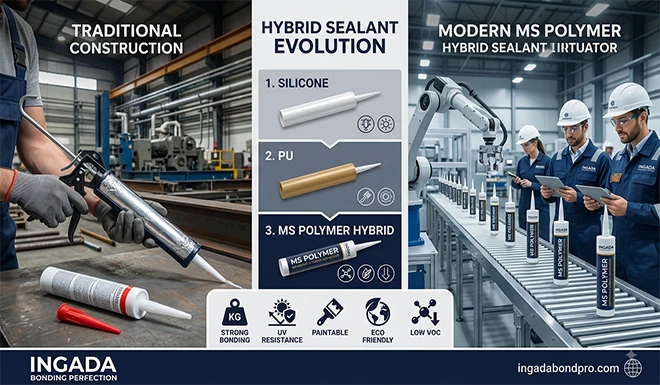
Hybrid sealants represent the next stage in industrial adhesive evolution by combining the advantages of polyurethane and silicone while reducing their limitations.
What Is Hybrid
Definition of Hybrid Sealant
A hybrid sealant is an advanced adhesive-sealant system that combines different polymer techno
The most widely adopted hybrid technology is:
MS Polymer (Modified Silane Polymer / SMP)
MS polymer sealants cure through moisture reaction and create a flexible polymer network that provides:
- High elasticity
- Strong substrate adhesion
- Weather resistance
- Paintability
- Low VOC characteristics
INGADA identifies MS Polymer as its core technology platform, combining sili
Why Are Hybrid Sealants Replacing Traditional PU and Silicone?
Industry Trend: The Shift From Single-Performance Materials to Balanced Solutions
Traditional sealants were
| Technology | Main Advantage |
|---|---|
| Silicone | Weather resistance |
| PU | Mechanical strength |
| Hybri | Balanced performance |
Modern industrial projects require multiple functions simultaneously.
For example:
A curtain wall project needs:
- UV resistance
- Joint movement capability
- Adhesion to different substrates
- Paint compatibility
- Long service life
A single traditional technology often cannot satisfy all requirements.
Hybrid sealants solve this performance gap.
Hybrid Seala
| Performance Factor | Hybrid MS Polymer Sealant | PU Sealant | Silicone Sealant |
|---|---|---|---|
| Bonding Strength | Excellent | Excell | Medium |
| UV Resistance | Excellent | Medium | Excellent |
| Elastic Recovery | Excellent | Good | Excellent |
| Paintability | ✅ Yes | Limited | ❌ No |
| Isocyanate-Free | ✅ Yes | ❌ No | Usual |
| Primer Requirement | Low / Primerless options | Often required | Application dependent |
| Substrate Compatibility | Very broad | Medium | Medium |
| Environmental Positioning | High | Medium | Medium |
| Structural Adhesive Capability | Excellent | Good | Limited |
Five Rea
1. Hybrid Technology Delivers Balanced Performance
Traditional procurement often required choosing between:
PU = strength
Silicone = weather resistance
Hybrid MS Pol
Industrial buyers no longer need to compromise between:
- Adhesion
- Flexibility
- W
- Appearance requirements
2. Better Outdoor Durability Than Traditional PU
Ou
- UV radiation
- Temperature changes
- Rainwater
- Freeze-thaw cycles
Traditional PU products may experience aging when continuously exposed outdoors.
Hybrid MS Polymer sealants provide improved weather resistance while maintaining elastic movement capability.
INGADA MS weatherproof series includes products designed for high-movement applications:
| Product | Movement Capability | Key Application |
|---|---|---|
| MS-625 | ±25% | Expa |
| MS-635 | ±35% | Curtain walls, infrastructure |
| MS-650 | ±50% | Seismic and high-movement structures |
3. Improved Sustainability Profile
Global procurement teams increasingly evaluate:
- VOC emissions
- Worker safety
- Environmental regulations
- Green building requirements
Hybrid sealants offer advantages including:
- Isocyanate-free chemistry
- Solvent-free formulations
- Lower odor
- Reduced migration risks
INGADA MS Polymer products are positioned with features including solvent-free formulation, primerless adhesion and eco-oriented characteristics.
4. Simplified Installation Reduces Total Project Cost
Material price is only one part of industrial procurement.
Total cost includes:
- Labor hours
- Primer preparation
- Rework risk
- Maintenance requirements
Hybrid sealants reduce installation complexity through:
- Primerless bonding capabili
- Multi-substrate adhesion
- Paint compatibility
This helps contractors improve project efficiency.
5. Hybrid Sealants Expand Application Possibilitie
Traditional sealants were often application-specific.
Hybrid technology allows one product family to serve multiple industries.
Construction
Applications:
- Facades
- Curtain walls
- Expansion joints
- Prefabricated buildings
Industrial Assembly
Applications:
- Metal bonding
- Panel installation
- Equipment assembly
Flooring Systems
Applications:
- Wood flooring
- PVC flooring
- Acoustic flooring
INGADA MS adhesive series includes solutions for construction bonding, vibration environments and industrial applications.
The Evolution of Industr
Stage 1: Traditional Silicone Era
Strengths
- Excellent weather resistance
- Long outdoor service life
Limitations
- Poor paint adhesion
- Limited structural bonding
Stage 2: Polyurethane Expansion Era
Strengths
- Strong adhesion
- Good mechanical properties
Limitations
- Isocyanate chemistry
- Lower UV resistance
- Often requires primers
Stage 3: Hybrid MS Polymer Era
Streng
- Silicone weather resistance
- PU-style bonding strength
- Paintable surface
- Flexible movement capability
- Better environmental profile
Application Selection Guide for Industrial Buyers
| Project Requirement | Recommended Technology |
|---|---|
| High UV exposure | Hybrid MS Polymer |
| Need painting after installation | Hybrid MS Polymer |
| Heavy structural bonding | Hybrid MS Polymer / PU |
| Green building projects | Hybrid MS Poly |
| Glass curtain walls | Silicone / Hybrid dependi |
| Expansion joints | Hybrid MS Polymer |
Procurement Checklist: How Global Buyers Evaluate Hybrid Sealants
Before selecting a supplier, industrial buyers should review:
Technical Performance
- Tensile strength
- Elongation
- Movement capability
- UV resistance
Compliance
- REACH
- RoHS
- VOC requirements
- ASTM-related standards
Supply Capability
- Product consistency
- Technical support
- OEM capability
- Documentation availability
INGADA operates under ISO 9001 quality management and supports international compliance documentation including REACH, RoHS, French
FAQ: Hybrid Sealant Questions from Industrial Buyers
Is hybrid sealant better than PU sealant?
For many modern construction and industrial applications, hybrid sealants provide a mor
Is hybrid sealant replacing silicone?
Hybrid sealants are not replacing every silicone application. Silicone remains impo
However, hybrid sealants are increasingly preferred where buyers require:
- Adhesion
- Paintability
- Low migration
- Environmental advantages
Why do contractors prefer MS Polymer sealants?
Because one product can often replace multiple materials:
- Sealant
- Adhesive
- Flexible bo
This simplifies inventory and installation.
Are hybrid sealants suitable for industrial exports?
Yes.
Global distributors increasingly p
Why INGADA Focuses on Hybrid MS Polymer Technology
INGADA develops MS Polymer adhesive and sealant solutions for global industrial markets.
Core capabilities include:
- MS adhesive series
- Weatherproof MS sealant series
- Structural bonding solutions
- International compliance support
- OEM and private label services
INGADA currently supports global markets across Europe, Middle East, Asia, Africa and the Americas.
Request Hybrid Sealant Technical Documents & Samples
For distributors, contractors and industrial procurement teams evaluating hybrid sealant solutions:
Contact INGADA technical engineering team for:
- Technical Data Sheets (TDS)
- Compliance documents
- Product samples
- Application recommendations
Email: hua@ingadabondpro.com
Discover more from INGADA The Ultimate Bonding Expert
Subscribe to get the latest posts sent to your email.