Private Label Sealant Manufacturing Guide: Building Your Own Brand

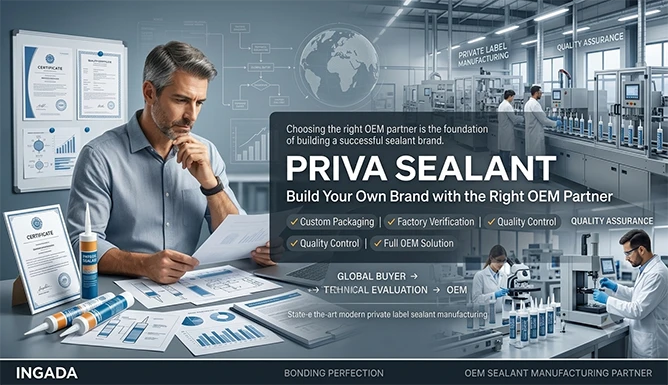
Introduction: Why More Companies Are Building Their Own Sealant Brands
The global construction and industrial adhesive market is becoming increasingly competitive. Distributors, building material suppliers, and regional importers are facing a common challenge:
How can they differentiate their products, improve profit margins, and build long-term customer loyalty without investing millions of dollars in their own factory?
The answer is increasingly becoming:
Private label sealant manufacturing.
Instead of purchasing existing branded products and competing only on price, many overseas companies are developing their own sealant brands through professional OEM manufacturing partners.
A complete private label sealant program allows companies to control:
- Product positioning
- Brand identity
- Packaging design
- Market pricing
- Distribution strategy
- Customer relationships
A qualified OEM partner provides the technical capability, production facilities, quality control system, and supply chain support required to transform an idea into a commercial product.
For international buyers, this means:
Build your own sealant brand without building your own factory.
What Is Private Label Sealant Manufacturing?
Private label sealant manufacturing means a specialized manufacturer produces sealant products according to a customer’s brand requirements.
The manufacturer provides:
- Formulation technology
- Raw material sourcing
- Production equipment
- Quality inspection
- Filling and packaging
- Documentation support
The buyer owns the brand identity and sells the finished products under their own name.
A typical private label sealant project includes:
| Stage | Manufacturer Responsibility | Buyer Responsibility |
|---|---|---|
| Product Selection | Recommend suitable formulas | Define target market |
| Technical Development | Provide TDS & specifications | Confirm application requirements |
| Packaging | Cartridge, label, carton customization | Approve artwork |
| Production | Batch manufacturing | Purchase planning |
| Quality Control | Testing & COA | Market distribution |
| Logistics | Export preparation | Import & sales |
Unlike simple trading, OEM manufacturing creates a deeper cooperation relationship between the brand owner and factory.
Private Label Sealant vs Contract Manufacturing Sealant
Many buyers confuse private label, OEM, and contract manufacturing.
Understanding the difference helps overseas companies choose the right business model.
Comparison Between Different Sealant Manufacturing Models
| Model | Definition | Suitable For |
|---|---|---|
| Traditional Trading | Buy existing products and resell | Small distributors |
| Private Label Sealant | Existing or modified products with your own brand | Importers building market identity |
| Contract Manufacturing Sealant | Manufacturer produces according to your technical requirements | Established brands |
| Full OEM Development | Customized formulation, packaging, and production system | Companies creating new product lines |
A professional contract manufacturing sealant partner should not only provide production capacity but also support:
- Product selection
- Application engineering
- Packaging optimization
- Compliance documentation
- Supply chain management
Why Overseas Buyers Choose Sealant OEM Manufacturing
1. Lower Investment Compared With Building a Factory
Establishing a sealant production facility requires:
- Chemical formulation capability
- Mixing equipment
- Filling machines
- Laboratory testing
- Raw material management
- Environmental compliance systems
For many distributors, this investment creates unnecessary financial pressure.
OEM manufacturing allows companies to enter the market with significantly lower initial investment while accessing professional production capability.
2. Faster Brand Launch
A traditional factory development project may require years.
With an experienced OEM partner, companies can move through:
Product selection → packaging design → sample approval → mass production
within a much shorter timeline.
For example, INGADA provides OEM private label support with customized branding and packaging solutions, with typical OEM delivery capability within 4–6 weeks depending on requirements.
3. Access to Professional Adhesive Technology
Sealant is not simply a filling product.
Performance depends on:
- Polymer chemistry
- Adhesion technology
- Curing mechanism
- Elastic recovery
- Weather resistance
- Environmental compliance
Professional OEM manufacturers provide access to technologies such as:
- MS Polymer sealant
- Silicone sealant
- Structural silicone
- PU sealant
- Flooring adhesive systems
INGADA’s product portfolio covers MS Adhesive, MS Weatherproof, Silicone Structural, Silicone Weatherproof, Flooring Adhesive, PU Foam and other adhesive categories, with 41 SKUs across 7 product series.
Step-by-Step Guide to Building Your Own Sealant Brand
Launching a successful sealant brand requires more than adding a logo to a cartridge.
A professional private label sealant project requires a complete system covering:
- Market positioning
- Product selection
- Technical specifications
- Packaging development
- Compliance documentation
- Production management
- Quality control
- Logistics support
The following seven-step process represents the typical workflow used by international distributors and construction material companies when developing their own sealant brands.
Step 1: Define Your Market Position and Target Customers
Before selecting products, brand owners should clearly define:
Who will buy your sealant?
Different markets require different product strategies.
For example:
| Target Customer | Recommended Product Focus | Key Selling Points |
|---|---|---|
| Building Material Distributors | General construction sealants | Stable supply, competitive pricing |
| Window & Door Companies | Weatherproof silicone sealant | UV resistance, durability |
| Contractors | MS Polymer adhesive | Strong adhesion, easy installation |
| Flooring Companies | Acoustic flooring adhesive | Low VOC, sound reduction |
| Bathroom Suppliers | Anti-mold sealant | Hygiene, long-term protection |
| Industrial Customers | Structural adhesive | Strength and reliability |
A successful brand does not start with dozens of products.
It starts with the right products for a specific market demand.
Step 2: Select the Right Sealant Product Portfolio
A common mistake for new brands is launching too many SKUs at the beginning.
A better approach is building a focused product portfolio:
Recommended Starter Private Label Sealant Portfolio
| Product Category | Application | Market Opportunity |
|---|---|---|
| MS Polymer Adhesive | Construction bonding, interior installation | High growth due to versatility |
| Weatherproof Silicone | Windows, facades, exterior joints | Large construction demand |
| Anti-Mold Sealant | Bathrooms, kitchens, hotels | Consumer and professional markets |
| Structural Silicone | Curtain walls, glass engineering | High-value projects |
| Flooring Adhesive | Wood, PVC, vinyl flooring | Commercial construction |
INGADA provides multiple adhesive categories including MS Adhesive, MS Weatherproof, Flooring Adhesive, Silicone Structural, Silicone Weatherproof, and PU systems, allowing distributors to develop different market combinations.
Product Selection Matrix for Private Label Brands
| Product Type | Main Technology | Typical Application | Brand Position |
|---|---|---|---|
| MS Polymer Sealant | Silane Modified Polymer | Construction bonding | Premium eco-friendly solution |
| Silicone Sealant | Silicone Polymer | Weather sealing | Reliable construction product |
| Structural Silicone | High-strength silicone | Glass facade | Engineering grade |
| PU Sealant | Polyurethane | Industrial joints | Heavy-duty applications |
| Flooring Adhesive | Polymer adhesive | Flooring installation | Healthy building solution |
Step 3: Develop Your Brand Identity and Packaging Design
Packaging is one of the most important elements of a private label sealant business.
A buyer does not only purchase chemical performance.
They purchase:
- Brand trust
- Professional appearance
- Market recognition
A complete OEM packaging project usually includes:
Cartridge Design
Key elements:
- Brand logo
- Product name
- Application icons
- Technical highlights
- Color identification system
Example:
INGADA MS Polymer Series
Could be positioned as:
- Flexible bonding technology
- Solvent-free solution
- Paintable adhesive
- Professional construction grade
Label Information Requirements
A professional sealant label normally includes:
| Information | Purpose |
|---|---|
| Product Name | Brand identification |
| Application | User guidance |
| Technical Features | Sales support |
| Curing Information | Installation requirement |
| Storage Information | Product safety |
| Batch Number | Traceability |
| Manufacturer Information | Compliance |
For international markets, multilingual labels may be required.
INGADA supports multi-language label solutions including Arabic, French, Spanish and other market requirements.
Step 4: Confirm Technical Documentation and Compliance
Professional buyers do not evaluate sealants only by price.
They check:
- Technical Data Sheet (TDS)
- Safety Data Sheet (SDS)
- Test reports
- Certifications
- Batch quality records
A reliable OEM manufacturer should provide technical documentation before mass production.
Typical documents include:
| Document | Purpose |
|---|---|
| TDS | Technical performance |
| SDS | Safety compliance |
| COA | Batch quality verification |
| Test Reports | Market acceptance |
| Certificate Documents | Import requirements |
INGADA operates under an ISO 9001 certified quality management system and provides documentation support for applicable standards including REACH, RoHS, French VOC A+, FDA and relevant ASTM requirements depending on product category.
Step 5: Sample Testing and Market Validation
Before large-scale production, professional brands should complete sample validation.
Recommended process:
- Product Selection → OEM Sample Production → Internal Testing → Customer Field Testing → Packaging Approval → Mass Production
Testing should evaluate:
- Adhesion performance → Curing speed → Surface compatibility → Weather resistance → Application experience
This stage reduces market risk and prevents costly product changes after launch.
Step 6: Batch Manufacturing and Quality Control
A professional contract manufacturing sealant partner must provide consistent production quality.
The manufacturing process normally includes:
Raw Material Inspection
Checking:
- Polymer quality
- Additives
- Pigments
- Functional materials
Automated Mixing
Ensuring:
- Formula accuracy
- Uniform performance
- Stable viscosity
Filling Process
Controlling:
- Cartridge weight
- Packaging quality
- Sealing performance
Final Inspection
Testing:
- Appearance
- Adhesion
- Cure behavior
- Batch consistency
Quality Control Checklist for OEM Sealant Production
| Control Point | Purpose |
|---|---|
| Raw Material Inspection | Prevent quality variation |
| Production Monitoring | Maintain formula accuracy |
| Finished Product Testing | Confirm performance |
| Batch COA | Provide traceability |
| Sample Retention | Support future analysis |
INGADA provides batch COA documentation and quality traceability support for shipments.
Step 7: Build a Long-Term Supply Chain Partnership
A successful sealant brand requires stable supply, not only a good first order.
Important supplier capabilities include:
Production Stability
Questions buyers should ask:
- Does the factory have dedicated production equipment?
- Can it support repeat orders?
- Are formulas stable?
Flexible Order Support
New brands often require:
- Mixed SKU orders
- Market testing quantities
- Regional packaging adjustments
INGADA supports distributor cooperation through product selection guidance, marketing materials, sample policies, OEM private label solutions and supply chain support.
Common Mistakes When Building a Private Label Sealant Brand
Mistake 1: Choosing Only Based on Price
Low-cost sealants may create:
- Customer complaints
- Returns
- Brand damage
A strong brand requires a balance between:
- Performance
- Cost
- Market positioning
Mistake 2: Launching Too Many Products
Too many SKUs create:
- Inventory pressure
- Marketing difficulty
- Slow turnover
A focused product strategy is usually more effective.
Mistake 3: Ignoring Local Regulations
Different markets may require:
- Label compliance
- VOC requirements
- Safety documentation
- Import certificates
Compliance should be considered before production.
FAQ: Private Label Sealant Manufacturing
Q1: What is the minimum investment required to start a private label sealant brand?
The investment depends on:
- Product range
- Packaging requirements
- Order quantity
- Market target
Many companies begin with a limited product portfolio and expand after market validation.
Q2: Can I create my own sealant brand without owning a factory?
Yes.
Private label manufacturing allows companies to build their own brands while using an experienced manufacturer’s production capability.
Q3: Can the packaging be customized?
Yes.
OEM programs commonly support:
- Cartridge printing
- Label design
- Carton packaging
- Brand colors
- Product naming
Q4: What types of sealants can be produced under private label?
Depending on manufacturer capability, private label programs may include:
- MS Polymer sealant
- Silicone sealant
- Structural silicone
- PU sealant
- Construction adhesives
- Flooring adhesives
Q5: How long does OEM sealant production take?
The timeline depends on product and packaging requirements.
INGADA provides OEM private label support with customized branding and packaging solutions, with typical OEM delivery capability within 4–6 weeks depending on project requirements.
Build Your Own Sealant Brand With a Complete OEM Partner
Creating a successful sealant brand requires more than manufacturing.
It requires:
- The right product strategy
- Reliable formulation technology
- Professional packaging
- Quality documentation
- Stable production capability
A qualified private label sealant manufacturer helps overseas companies transform market opportunities into commercial products.
From product selection and packaging design to batch manufacturing and global delivery, a complete OEM solution allows distributors and contractors to build competitive brands without investing in their own chemical production facility.
Discover more from INGADA The Ultimate Bonding Expert
Subscribe to get the latest posts sent to your email.