Quick Answer
The procurement sequence around these joints — who specifies what, and in which order — is covered in the joint-sealing procurement guide.
A window perimeter is not one joint. It is two: an exterior joint that has to survive rain, UV and thermal cycling, and an interior joint that has to be clean, paintable and low-odour. Most perimeter failures come from treating them as one.
Three things decide the product, in this order:
- Substrate pair — aluminium to concrete behaves nothing like aluminium to ALC block.
- Movement — the frame moves differently from the wall, and the joint has to absorb the difference.
- Whether the joint will be painted — silicone cannot be painted; MS polymer can.
Everything else — brand, price, packaging — is secondary to those three.
1. Four Variables That Decide the Specification
| Variable | What it changes | Typical options |
|---|---|---|
| Frame material | Adhesion and movement differential | Aluminium, uPVC, timber, steel |
| Wall substrate | Chemistry of the bond | Concrete, mortar, brick, ALC block, precast panel |
| Movement | Displacement class | ±20%, ±25%, ±35%, ±50% |
| Exposure | Weathering and finish requirements | Exterior face, sheltered soffit, interior reveal |
The frame material matters less for adhesion than for movement. Aluminium has a coefficient of thermal expansion roughly twice that of concrete, so a 3 m frame moves noticeably more than the wall it sits in. That differential is what the sealant absorbs, and it is the reason a perimeter joint on a south-facing elevation needs more displacement capability than the same detail on a shaded one.
2. Joint Geometry: Why Width-to-Depth Ratio Decides the Outcome
A perimeter joint that is too shallow fails in a predictable way: the sealant has nowhere to stretch, so it peels from one face instead of elongating.
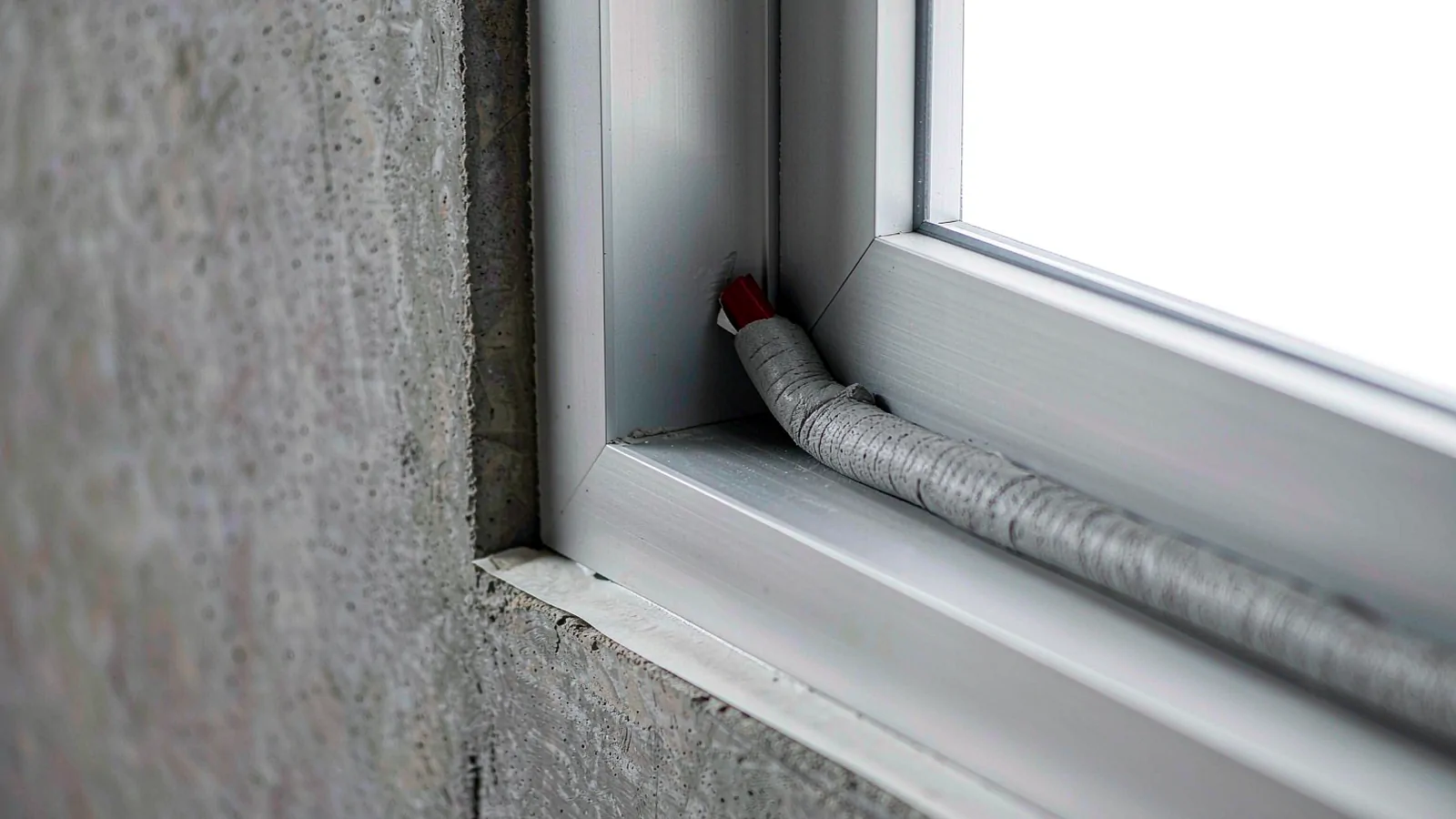
The working rule for a movement joint is a width-to-depth ratio of about 2:1, with a minimum depth that keeps the bead structurally continuous, and a backer rod to set the depth and prevent three-sided adhesion.
Three-sided adhesion is the most common installation defect in this category. When sealant bonds to the two joint faces and to the back of the gap, it cannot deform in shear; the first significant movement tears the bond line. A closed-cell backer rod, or a bond-breaker tape on the back face, removes the third bond.
Practical checks before sealing:
- Joint depth is set by backer rod, not by how much sealant the installer has left.
- The joint is dry and dust-free; concrete reveals are often damp for days after a wet trade.
- Masking is used where the finish must stay clean — tooling against an un-masked porous reveal leaves a stain line that cannot be removed.
3. Choosing the Displacement Class
Most domestic and standard commercial window systems are designed around ±25%. That is the default grade, and it covers the majority of perimeter details.
Move up when:
- The elevation is long and unbroken, so cumulative movement is higher.
- The frame is dark-coloured or metallic, which runs hotter.
- The building is tall enough that wind-induced racking adds to thermal movement.
- The joint is wide, or the wall substrate is dimensionally unstable (timber frame, lightweight block).
In the INGADA range the two reference points are:
- SR-25 — ±25% (Class 25), tensile strength ≥0.8 MPa, elongation ≥350%, the standard perimeter grade.
- SR-35 — ±35%, 100% modulus ≤0.6 MPa, elongation ≥500%, hardness 30–40, and a formulation without oil that does not migrate into porous reveals.
For an economy-driven project, dropping to a 20% grade on sheltered or short joints is a legitimate cost lever — but it must be a decision, not an accident of what was in stock.
4. Silicone or MS Polymer at the Perimeter?
This is the choice that most affects callbacks, and it is decided by two questions.
Will the joint be painted? Silicone surfaces cannot be overcoated; paint forms craters or beads off. If the perimeter will be rendered, painted or plastered over, use an MS polymer. MS-625 is a low-modulus polyether at ±25% with tensile strength ≥1.4 MPa and elongation ≥450%, and it accepts paint once cured.
Is the substrate porous and alkaline? Concrete, mortar, brick and ALC block are hostile to silicone adhesion over time, particularly where moisture migrates through the wall. MS polymer adheres more reliably to these substrates — MS-625 carries concrete adhesion ≥1.2 MPa, which is the figure to ask for when the reveal is concrete or precast.
Where the joint is between coated aluminium and glass, or the frame is a system window with a controlled finish, silicone remains the simpler answer: better UV stability, no paint interaction, and a well-established specification route.
One more distinction worth putting in writing: the interior bead and the exterior bead are different specifications on the same window. The exterior needs weathering and movement; the interior needs low odour, cleanliness and paintability. Specifying one product for both is how projects end up with a paintable interior seal that fails outdoors, or a weathered exterior bead that cannot be decorated.
5. What the Weather Seal Does Not Do
A perimeter seal is not an air barrier and not a drainage plane. Three functions are commonly conflated in a window interface:
| Function | Provided by |
|---|---|
| Water shedding and drainage | Sill flashing, weep paths, cavity drainage |
| Air tightness | Membrane or tape system behind the frame |
| Movement accommodation and weather seal | The perimeter sealant |
If water reaches the sealant and has no path out, the joint will eventually fail regardless of product quality. When a client reports recurring perimeter dampness, check the drainage detail before re-specifying the sealant — a better sealant over a blocked weep path simply moves the problem.
6. What to Put in the Specification and the RFQ
A perimeter sealant specification that can actually be procured contains:
- Substrate pair, written as a pair, not as “concrete” and “aluminium” in separate clauses.
- Joint dimensions — width, depth, and the intended width-to-depth ratio.
- Displacement class, with the movement calculation attached.
- Exposure — orientation, shelter, whether the joint is in a wet zone.
- Finish — painted, rendered, or exposed; this decides silicone versus MS.
- Interior and exterior listed separately, with different products where the requirements differ.
- Documentation required — TDS, adhesion data on the actual substrates, and the compliance statement the project accepts.
For the wider detail set, see windows, doors and joints solutions.
For outdoor work, the compliance wording our documents support is: CE for mechanical performance, ISO 9001 quality system with ISO 11600 product standard, and RoHS. Where a project asks for indoor air-quality marks on an exterior joint, that is a scope confusion worth resolving early rather than a document to chase.
Discuss Your Window and Door Joint Requirements with INGADA
If you are specifying perimeter joints for a window or door system, prepare the joint detail: frame material, wall substrate, joint width and depth, calculated movement, whether the joint will be painted, and the destination market’s documentation requirements.
INGADA can review the stated parameters, confirm which grades fit the joint geometry and movement, and identify what needs a site measurement or a project-specific test before the specification is issued.
Suitability depends on the actual substrate pair, joint geometry and movement calculation. Confirm the product against the project detail before ordering.