Quick Answer
Roof and facade joints share most of their failure logic; the joint-sealing procurement guide covers the parts that apply to both.
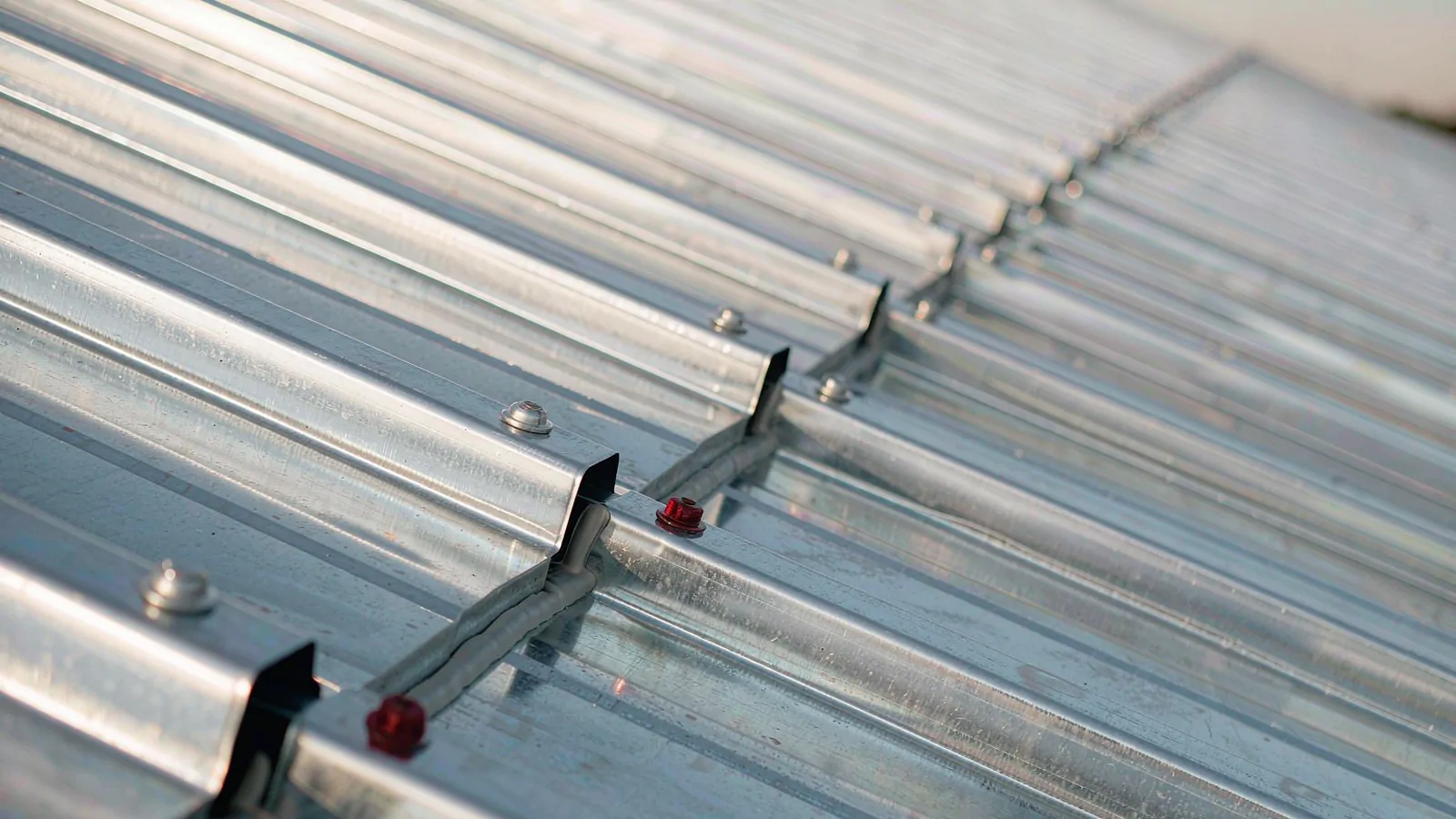
A metal roof contains three different sealing problems, and they are usually bought as if they were one.
| Zone | What it has to survive | Wrong choice fails by |
|---|---|---|
| Ponding zones — gutters, outlets, low spots | Standing water, warm water, repeat wetting | Adhesion loss at the interface |
| Lap and expansion joints — sheet-to-sheet, ridge, verge | Large thermal movement | Cohesive tearing or bond-line peel |
| Edge trim, flashings and fixings | Wind uplift, immediate load | Slump before cure, fastener loosening |
One product cannot be best in all three. If a quotation offers a single “roof and gutter sealant” for the whole detail, that is the first thing to question — not the price.
1. Why Metal Roofs Are a Harder Sealant Environment Than Walls
Three properties of metal roofing drive every specification decision.
Movement is large and fast. A 10 m aluminium sheet moves about 14 mm across a 60 K surface-temperature swing (α ≈ 23 × 10⁻⁶/K); a steel sheet moves about 7 mm. That movement happens daily, not seasonally, and it is concentrated at the joints.
The substrate is thin and flexible. Panels deflect under foot traffic, wind pressure and thermal buckling. The sealant is bonded to a surface that bends, so it is loaded in a way a wall joint never sees.
Surfaces are coated, and coatings vary. Coil-coated steel, PVDF aluminium and plastisol all present different surfaces. Adhesion has to be established against the actual finish, not against “metal”.
Add surface temperature: a dark metal roof in direct sun commonly reaches 70–80 °C, well above ambient. A product rated to +90 °C is working with a 10–20 °C margin, not a comfortable one.
2. Ponding Zones: The Test Is Hot Water, Not Water
Gutters, outlets and low spots are wet for long periods, often at elevated temperature, often with debris. The failure is not a cohesive split — it is the bond line letting go.
The relevant evidence is therefore a wet-ageing test, and the number to ask for is retention after hot-water immersion. MS-35W is the grade in the INGADA range built for this zone: in-water shear strength ≥2.8 MPa, no interface failure after 50 °C / 168 h immersion, and ≥95% strength retained at 336 h, with Shore A hardness 60 ± 5 and a non-sag, solvent-free paste.
Two practical notes:
- A standard weather sealant — even a good one — is not a ponding sealant. It may pass 1,000 hours of weathering and still fail in a gutter within a season, because weathering tests and immersion tests measure different things.
- Ponding zones should also be detailed so they drain. A sealant is not a substitute for fall, outlet sizing and debris control.
3. Lap and Expansion Joints: Elongation Before Strength
Lap joints move more than any other roof detail. The requirement is elongation and low hardness, because the sealant must follow the sheet rather than resist it.
For this zone the reference product in the range is MS-620: elongation at break ≥680%, tensile strength ≥2.7 MPa, Shore A hardness 30 ± 5, non-sag paste suitable for slopes and soffits, service range −40 to +90 °C, and paintable after cure.
The critical reading is the disclaimer: MS-620 is not intended for permanently immersed conditions. It is the right product for a dry-side lap joint and the wrong one for a gutter, which is exactly why the three-zone split matters. Roofs commonly have both details within two metres of each other.
When evaluating a competitor’s lap-joint product, ask for elongation at break and hardness together. A high-elongation claim paired with a hard, high-modulus bead usually means the elongation figure was obtained on a laboratory dumbbell, not on a constrained joint.
4. Edge Trim, Flashings and Fixings: Initial Grab Is the Governing Property
On a slope, the sealant has to hold the trim in place while it cures. If initial grab is slow, the component slides, the bead thins, and the detail leaks from the first rain.
MS-35 is specified for this zone: initial positioning grab ≤15 s, shear strength ≥3.0 MPa, Shore A hardness 55 ± 5, service range −30 to +100 °C. The high hardness is intentional — this is a bonding and fixing application, not a movement joint.
Wind uplift at edges and corners is the dominant load. Published uplift test data usually assumes a continuous, correctly bonded edge; a bead that has slumped or been applied over a contaminated surface invalidates that assumption. Which is why edge fixing and edge sealing are one operation, not two.
5. Coated Metal Compatibility: Ask About the Finish, Not the Metal
Three compatibility issues recur:
- Acid-cure silicone on metal. Acetic-cure products release acid during cure, which attacks galvanised and coated steel and can stain the finish. Specify neutral-cure for metal roofing as a baseline requirement.
- Plasticiser migration. Some low-cost sealants plasticise and stain light-coloured coil coatings, leaving an irreversible dark halo around the bead. Ask specifically whether the product is plasticiser-migration tested on coated metal.
- Dissimilar materials. Where aluminium trim meets steel sheet or stainless fasteners, moisture creates a galvanic couple. The sealant should not be the only separation; isolation tape at the contact face is a detail check worth putting in the method statement.
For the full detail set, see metal roofing and flashing solutions.
For outdoor roofing work, the compliance statement the documents support is CE for mechanical performance, ISO 9001 quality system with ISO 11600 product standard, and RoHS. Where a tender asks for indoor air-quality marks on a roof product, clarify the scope rather than chase the document.
6. Failure Modes Worth Knowing by Sight
| What you see | Usual cause |
|---|---|
| Water tracks at the low end of a lap | Insufficient bead compression or contamination at the lap |
| Bead pulled cleanly off one face, glossy surface intact | Adhesion failure — often ponding zone sealed with a non-immersion product |
| Split down the middle of the bead | Cohesive failure from movement exceeding the product’s class |
| Trim displaced, fasteners loose, bead intact | Wind uplift; the fixing, not the sealant, was the weak point |
| Dark staining around a light-coloured bead | Plasticiser migration into the coating |
Only two of those five are solved by changing the sealant. The others are detailing and fixing issues, and no product upgrade will fix them.
7. Specification and RFQ Checklist
Give suppliers the following, and the comparison becomes meaningful:
- Zone map — which details are ponding, which are lap joints, which are edge trim.
- Substrate and finish — including the coil coating type where known.
- Panel length and material — this sets the movement the joint has to absorb.
- Surface temperature range in service, not just ambient.
- Slope and orientation — non-sag requirement.
- Test evidence required — hot-water immersion retention for ponding zones; elongation and hardness for lap joints; grab time and shear for trim.
- Compliance statement accepted by the project for outdoor use.
Three products, three zones, one schedule: that is the structure that survives both the roof and the tender review.
Discuss Your Metal Roofing Requirements with INGADA
If you are evaluating sealants for a metal roofing or flashing system, prepare the zone map, the substrate and coating type, panel lengths and material, expected surface temperatures, roof slope, and the test evidence your project requires.
INGADA can review the stated conditions, confirm which grades match each zone, and identify what still needs a project-specific adhesion test or site trial before the schedule is issued.
Suitability depends on the coating system, joint geometry and service temperature. Confirm each zone against project-specific test evidence before ordering.