Quick Answer
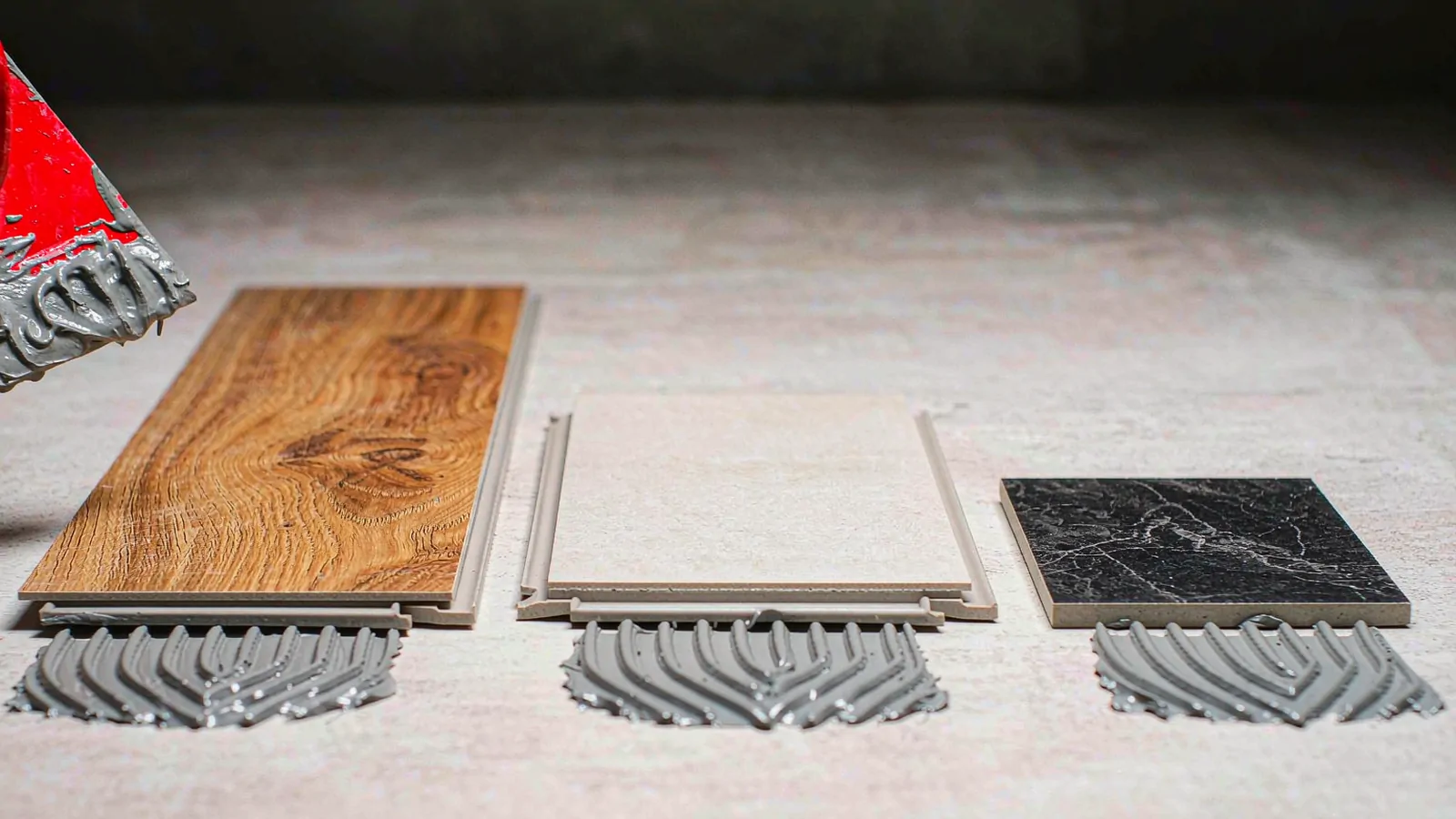
“Flooring adhesive” is a category name, not a specification. Three systems that look similar on a sample board behave completely differently under the same adhesive:
- Wood moves with humidity. The adhesive has to stay elastic, or the stress goes into the board.
- SPC is a rigid composite with a click edge. The adhesive has to hold flat without filling the locking profile.
- PVC and LVT contain plasticiser, which migrates into adhesives and into the wrong substrate. The adhesive has to resist it and still grip a smooth, low-absorption surface.
Specify in that order — system, then movement, then adhesive — and most of the failures in this category disappear before the first pallet ships.
1. The Governing Property Is Different for Each System
| System | What decides success | Failure if the adhesive is wrong |
|---|---|---|
| Solid and engineered wood | Elasticity — the bond must move with the board | Cupping, tenting, open joints at the plank ends |
| Bamboo, SPC | Flat bond plus high initial tack on a low-absorption core | Hollow spots, drumminess, edge lift |
| PVC, LVT, resilient | Shear strength on smooth substrates and plasticiser resistance | Adhesive softening, tile creep, staining at the edges |
A single product can serve more than one system only where the values genuinely overlap. Ask for the shear strength and hardness on the actual substrate, not the headline tensile figure.
2. ISO 17178: the Classification That Answers “How Elastic?”
Wood flooring has an international reference point that most buyers never see quoted: ISO 17178 (also published as BS EN ISO 17178), Adhesives — Adhesives for bonding parquet to subfloor. It splits flooring adhesives into three classes by shear strength and shear deformation:
| Class | Requirement | What it means on site |
|---|---|---|
| Hard | Shear ≥ 3.0 N/mm² | Rigid fixing; for structural or specialised assemblies |
| Hard elastic | Shear ≥ 2.0 N/mm² and γ ≥ 0.5 | Strength with controlled movement |
| Elastic | Shear 1.0–2.0 N/mm² and γ ≥ 1.0 | The normal answer for wood on a heated or humid floor |
The reason the standard bothers with two elastic classes is that a harder adhesive is not a better one for timber. A rigid bond converts the board’s own movement into stress inside the plank; the visible result is a cupped or split board, months later, with the adhesive still intact.
Where the INGADA range sits:
- MS-77 — shear 1.2–2.0 MPa, Elastic class; the general wood and SPC grade, with a non-phthalate plasticiser system and underfloor-heating suitability.
- MS-77C — the economy wood grade at the same shear band.
- MS-77P — shear 1.8–2.5 MPa, reaching Hard elastic at the top of the band, longer open time (40–60 min) for large areas and complex patterns.
- MS-77PVC — PVC and resilient specialist, Shore A ≥ 60, LVT-to-screed shear ≥ 1.0 MPa.
Choosing between MS-77 and MS-77P is usually an open-time and job-size decision; choosing between either of them and MS-77PVC is a system decision and cannot be swapped.
3. Wood: Humidity, Not Strength, Is the Risk
Two numbers matter more than any strength figure.
Substrate moisture content ≤ 4%. Above that, the adhesive is being asked to bond to a moving surface. A moisture test before the first tub is opened is cheaper than any call-back.
Open time against the installation rate. 20–40 minutes is normal for standard plank; 40–60 minutes is what makes a large-format or herringbone install possible without re-trowelling. A crew that runs out of open time starts laying into a skinned adhesive, and the bond is already compromised before the plank goes down.
For heated floors the requirement moves from “elastic” to “elastic and thermally stable”: a service range that stays clear of the surface temperature, and a bond that survives repeated cycles rather than a single peak. The system view of that problem — including the acoustic layer — is covered in flooring adhesives for acoustic and underfloor heating.
4. SPC: A Rigid Core Changes the Adhesive’s Job
SPC planks are dimensionally stable, so movement is not the issue. Three other things are:
- Low absorption. The core does not pull adhesive in, so the bond depends entirely on wetting and contact. Full-spread application with the correct notch size matters more than on wood.
- Initial tack. Rigid planks do not conform to the substrate; if the adhesive does not grab, the plank bridges a hollow.
- The locking edge. Adhesive squeezed into a click profile prevents the joint closing properly. Keep the bead clear of the profile and clean the edge before it skins.
Where SPC sits over a heated screed, the same thermal rules as wood apply, but the adhesive’s contribution is flatness and contact rather than movement accommodation.
5. PVC and LVT: Plasticiser Is the Hidden Variable
Resilient flooring contains plasticiser, and plasticiser migrates. Two consequences drive specification:
- The adhesive must not be softened by it. A plasticiser-sensitive adhesive under LVT turns into a creeping layer, and the tiles slide at the joints. This is why a PVC-specific grade exists rather than a “general” one.
- The substrate must be sealed or compatible. Fresh screed, gypsum-based levelling compounds and some old adhesive residues react badly. A primer is not optional on porous or dusty substrates.
Two figures to request for this system: shear on LVT-to-screed (≥ 1.0 MPa in the INGADA PVC grade) and Shore A hardness ≥ 60, which keeps the bond firm under point loads and rolling chairs.
6. Indoor Certifications Are Legitimate Here — and Only Here
Flooring adhesives are indoor products, so the indoor documentation set applies: REACH, French A+ and FDA food-contact compliance are appropriate for MS flooring adhesives, alongside CE, ISO 9001 with ISO 11600, and RoHS.
That is the opposite of the facade articles in this series, where indoor air-quality marks are out of scope. Mixing the two sets in one submittal is a common way to lose credibility with a technical reviewer: an exterior sealant claiming A+ invites questions about what else was copied from another datasheet.
Also worth stating plainly for sensitive projects — hospitals, schools, hotels: low VOC and no phthalate plasticiser are the two properties that keep a flooring installation usable the day after handover.
7. Specification and RFQ Checklist
- System named explicitly — solid wood, engineered, bamboo, SPC, LVT, vinyl sheet, rubber.
- Substrate — screed, plywood, existing tile, levelling compound; and the moisture reading.
- Format and pattern — plank width, herringbone, large format; this decides open time.
- Service conditions — underfloor heating, solar gain, commercial point loads.
- Coverage per m², so the quotation can be normalised.
- Certification set for indoor use, and the market it is destined for.
- Packaging and pallet quantity, if the project is priced per pallet.
The procurement sequence around these decisions — how many models to carry, how to phase an order — is set out in the flooring and interior bonding procurement guide.
Discuss Your Flooring Project with INGADA
If you are specifying an adhesive across more than one flooring system, prepare the system list, substrate and moisture results, service conditions, coverage expectations and the destination market’s documentation requirements.
INGADA can confirm which grade fits each system and movement class, and identify where a single product can safely serve two systems and where it cannot.
Suitability depends on the flooring system, substrate and service conditions. Confirm coverage and class against the project specification before ordering.