Quick Answer
Two requirements are usually written into one floor specification, and they are not the same problem.
Underfloor heating is a durability question: the adhesive has to survive continuous thermal cycling at 40–50°C at the floor surface without softening, flowing or embrittling, while still moving with the timber as it expands and contracts.
Impact sound is a system question: the reduction achieved depends on the adhesive layer, the perimeter and penetration details, and the void or floating layer — together. Replacing the adhesive alone will not meet a ΔLw acceptance criterion, no matter which product is chosen.
Confusing the two produces the most expensive failure in this category: a floor that is acoustically compliant on paper and hollow-sounding after the first heating season.
1. What Underfloor Heating Actually Changes
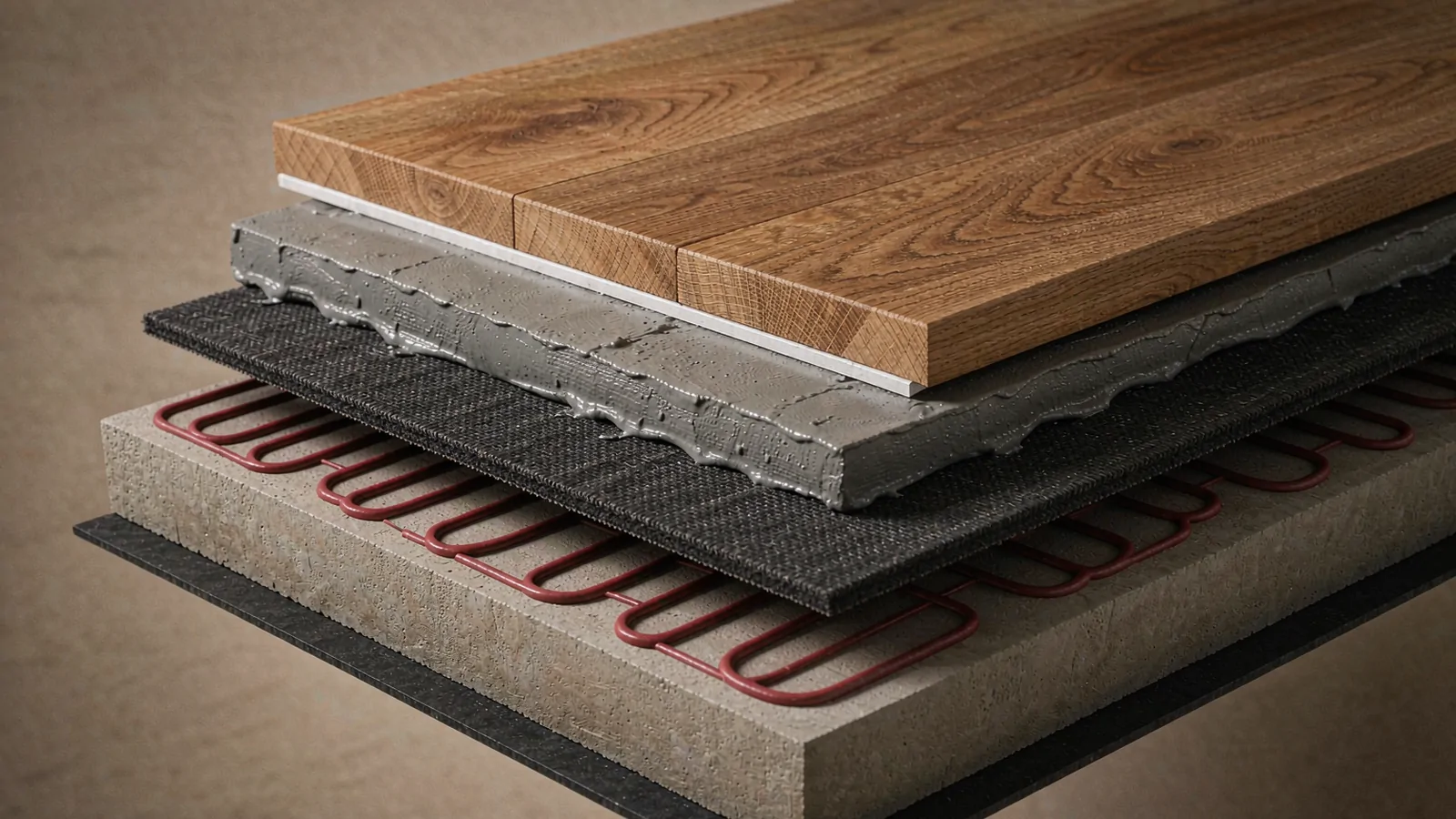
A heated slab is not simply a warm floor. It changes four things that matter to the adhesive:
| Condition | Consequence for the adhesive |
|---|---|
| Continuous elevated temperature | Bond strength at 50°C is the relevant figure, not strength at 23°C |
| Cyclic heating and cooling | Repeated expansion and contraction loads the bond line |
| Faster substrate warm-up | Working time shortens; large-area installation needs a longer window |
| Heat transfer through the bond | Requires full-spread bonding, not spot application |
The practical requirement is a service temperature ceiling comfortably above the floor’s surface temperature. In the INGADA flooring range the ceiling is +90°C, well clear of a typical 40–50°C screed surface.
2. Elasticity, Not Strength, Is the Governing Property
The instinct when specifying for heat is to ask for a stronger adhesive. That is the wrong lever.
Timber expands when heated. A rigid adhesive transfers that expansion into the plank, and the plank responds by cupping, tenting or opening at the joints. An elastic adhesive deforms with the movement and recovers.
The relevant specification language is elastic classification, not tensile strength alone. In the INGADA range, MS-77C carries EN 14293:2006 classified as Elastic, with hardness around 35–45 Shore A and shear strength 1.2–2.0 MPa — an elastic profile, not a structural one.
A specification that asks only for “high strength” will tend to select the wrong product for a heated floor.
3. ΔLw: What It Measures, and Which Product Carries It
ΔLw is the weighted reduction in impact sound pressure level. It describes how much a floor assembly reduces footfall, dropped objects and chair noise compared with a reference floor.
Three points that matter in procurement:
- ΔLw belongs to the assembly. Adhesive, screed, resilient layer, covering and flanking details all contribute. A product figure describes the product’s contribution under defined test conditions.
- The tested build-up and method must be stated. Two ΔLw figures are comparable only when the assemblies match.
- The project target comes from the acoustic designer, not from a product catalogue.
In the INGADA flooring range, the product carrying a quantified impact sound figure is MS-77P — ΔLw ≥16 dB. It is the only flooring adhesive in the range with a quantified value for impact sound reduction. MS-77 and MS-77C are specified for heated floors but do not carry a ΔLw value of their own.
This distinction matters more than it looks. If a tender asks for a ΔLw figure and the quoted product has no such figure, the submittal fails regardless of how well the floor performs in practice.
4. Noise Control Is Three Layers, Not One Product
A completed acoustic floor normally relies on three measures, and specifying only the first is the most common reason a compliant design fails on site.
| Layer | Function | Product type in the INGADA range | Documented figure |
|---|---|---|---|
| ① Adhesive layer | Absorbs part of the impact energy; avoids a rigid sound bridge under the covering | MS-77P | ΔLw ≥16 dB |
| ② Perimeter and penetrations | Interrupts sound bridges at wall junctions, skirtings and pipe penetrations | MS-722 damping sealant | STC ≥56 dB / IIC ≥50 dB, loss factor η ≥0.15 |
| ③ Void or floating layer | Blocks structure-borne transmission and suppresses cavity resonance | PU-66 acoustic PU foam | NRC ≥0.70, 50× expansion |
Two notes on the third layer: PU-66 is Class B3 (combustible) and must not be used where a fire separation requirement applies — confirm local fire rules before specifying it indoors. And PU-66 is a two-component foam, so it is a separate trade activity from the flooring work.
The commercial consequence is worth stating plainly: if a client asks “which adhesive is quietest”, the useful answer is that no adhesive alone will meet an acceptance criterion, and the specification needs all three layers.
5. Selecting Within the Heated Floor Options
The range contains three flooring adhesives with documented underfloor heating suitability. They are not interchangeable on price and open time.
| MS-77 | MS-77C | MS-77P | |
|---|---|---|---|
| Position in range | Standard heated floor | Economy heated floor | Premium acoustic |
| Underfloor heating | Yes — TDS states heated installation, heat-cycling resistance and retained elasticity | Yes — TDS states suitable for wood and resilient flooring on heated screeds | Yes — TDS includes an Underfloor Heating entry |
| ΔLw | No figure | No figure | ≥16 dB |
| Hardness (Shore A) | 35–45 | 35–45 | 38–45 |
| Tensile strength | 1.5–2.2 MPa | 1.5–2.2 MPa | 2.0–2.5 MPa |
| Shear strength | 1.2–2.0 MPa | 1.2–2.0 MPa | 1.8–2.5 MPa |
| Open time | 20–40 min | 20–40 min | 40–60 min |
| Coverage | — | 800–1400 g/m² | 800–1500 g/m² |
| VOC | Low VOC | Low VOC | ≤1.5% |
| Cure rate | — | 24–72 h | 4 mm / 24 h (ISO 7389) |
| Classification | — | EN 14293:2006 — Elastic | — |
How to choose between them:
- Acoustic acceptance criterion in the project → MS-77P. It is the only one with a ΔLw figure.
- Large area or complex parquet → MS-77P, on open time (40–60 min) alone.
- Standard heated residential or office floor, cost-sensitive → MS-77C.
- Environmental acceptance, low-emission requirement → MS-77P at VOC ≤1.5%.
- Fast track, need to get onto the floor early → MS-77P or MS-77W, both documented at 4 mm/24 h cure rate. Note that this is cure rate, not surface dry time — they are different things.
For the floor assemblies these products are specified into, see flooring and sports surfaces.
6. Substrate and Commissioning Conditions
Two conditions cause more heated-floor failures than product selection does.
Substrate moisture ≤4%. This is a hard threshold for the adhesive, and a heated screed is not automatically a dry screed. Where moisture exceeds the limit, the remedy is a moisture-control layer, not a more tolerant adhesive.
Where the substrate needs moisture-proofing, surface sealing, or improved adhesion — new concrete, timber substrates, renovation over old tiles, or a highly absorbent screed — a primer is the appropriate measure. PU-D01 single-component polyurethane primer is documented for this: penetration up to 2 mm, coverage 250–400 g/m², tack-free in roughly 30–40 minutes, and floor covering can follow 4 hours later. It sits at the base of the system and is not affected by the heating, but the substrate moisture requirement still applies.
First heating must be gradual. Bringing a heated screed up to temperature quickly, before the adhesive has developed strength, is a documented cause of debonding and joint opening. Follow the screed manufacturer’s commissioning programme and the adhesive’s cure data rather than the project schedule.
7. What to Verify Before Approving
- Is underfloor heating named in the TDS for the exact model, not just implied by the product family?
- Service temperature ceiling versus the design surface temperature.
- Elastic classification or equivalent — not tensile strength alone.
- ΔLw figure and its tested assembly, if the project has an acoustic criterion.
- Coverage rate from the manufacturer, for the intended trowel and substrate.
- Open time against the actual installation window on a warm screed.
- Substrate moisture measured, recorded, and within limit.
- Perimeter and penetration details specified together with the adhesive, not after.
- Primer requirement stated, with the product and the waiting time.
Frequently Asked Questions
Can any flooring adhesive be used over underfloor heating?
Only where the technical data sheet states underfloor heating within the intended application and the service temperature covers the system. In this range, MS-77, MS-77C and MS-77P all carry that documentation; a general-purpose flooring adhesive should not be assumed suitable.
Which product provides the ΔLw ≥16 dB figure?
MS-77P. It is the only flooring adhesive in the range with a quantified impact sound value. MS-77C is specified for heated floors and is classified elastic, but does not carry a ΔLw figure.
Will a ΔLw ≥16 dB adhesive give me 16 dB in my building?
No. The achieved reduction depends on the complete assembly — screed, resilient layer, covering and flanking details — and on workmanship. The product figure is a contribution under defined test conditions.
Is the heating switched on during installation?
This is project- and product-specific. Many systems require the heating off during application and cure. Confirm in the TDS and the project specification before work starts.
How is impact noise actually reduced to an acceptance level?
By three layers: the adhesive layer, the perimeter and penetration details, and the void or floating layer. Specifying only the adhesive is the most common reason a compliant design fails on site.
Discuss Your Acoustic Floor Requirements with INGADA
If you are specifying a heated or acoustic floor, prepare the floor build-up, the required impact sound performance and its test method, the heating system’s surface temperature, the substrate moisture result and the destination market before requesting documentation.
INGADA can confirm which model documentation applies to your build-up and identify what still needs verification before the specification is issued.
Impact sound performance depends on the complete floor assembly, not on the adhesive alone. Confirm the system against project-specific test evidence.