How to Choose the Right Construction Sealant: Start With the Substrate, Not the Cartridge

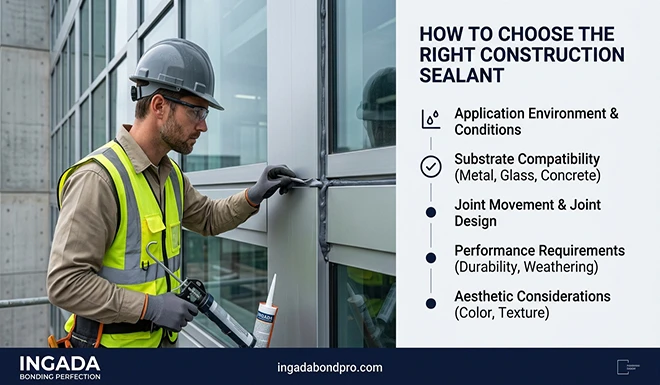
Construction sealant selection is not simply a matter of choosing silicone, MS polymer, or polyurethane. The correct sealant depends on the substrate, joint movement, exposure conditions, required adhesion, and whether the joint is intended for weatherproofing, glazing, or structural bonding.
For contractors, facade engineers, distributors, and specifiers, three questions should come first:
- What materials are being sealed or bonded?
- How much movement will the joint experience?
- Is the sealant required for weatherproofing, glazing, or structural bonding?
These questions become especially important in facade applications involving glass, concrete, and aluminum panels. A sealant that performs well on one substrate may not be appropriate for another.
This guide provides a practical construction sealant selection framework and a substrate-based decision matrix for choosing the right facade sealant.
1. Construction Sealant Selection: The Five Factors That Matter
Before comparing products, evaluate the joint using five technical factors.
| Selection Factor | What to Check | Why It Matters |
|---|---|---|
| Substrate | Glass, concrete, aluminum, stone, PVC, etc. | Determines adhesion and compatibility |
| Joint Movement | ±20%, ±25%, ±35%, ±50% | Determines required elasticity |
| Exposure | UV, rain, freeze-thaw, humidity, heat | Determines weathering requirements |
| Joint Function | Weatherproofing, glazing, structural bonding | Determines sealant technology |
| Aesthetic Requirements | Clear, translucent, color-matched, paintable | Affects silicone vs. MS polymer selection |
The key principle is simple:
Do not select a sealant by product name alone. Select it by substrate + movement + environment + function.
For example, a curtain wall joint exposed to strong UV radiation and large thermal movement requires a different solution from an interior concrete joint.
2. Silicone vs. MS Polymer: Which Construction Sealant Should You Choose?
Silicone remains an important technology for exterior weatherproofing and structural glazing. MS polymer, meanwhile, can offer advantages where paintability, low migration, or primerless adhesion are priorities.
INGADA’s product portfolio describes MS polymer as combining silicone-like weather resistance with polyurethane-like adhesion while providing paintability, zero migration, solvent-free formulation, and high elasticity.
| Technology | Main Advantages | Typical Limitation | Typical Construction Use |
|---|---|---|---|
| Silicone | Excellent UV and weathering resistance | Generally not paintable; formulation-specific migration/staining considerations | Curtain walls, glazing, exterior joints |
| MS Polymer | Paintable, flexible, solvent-free, low migration | May have higher material cost than standard silicone | Expansion joints, prefab structures, facade joints |
| Polyurethane | Strong adhesion and structural strength | Lower UV resistance; may require primer depending on application | Construction joints and specialized bonding |
For facade projects, the right choice is therefore determined by joint function, not simply by chemistry.
3. Construction Sealant Selection Decision Tree
A practical decision tree for common facade substrates can be summarized as follows:
Step 1: Identify the substrate
Glass → Determine whether the joint is structural glazing, glass weatherproofing, or decorative/transparent sealing.
Concrete → Determine whether the joint is an expansion joint, precast joint, facade perimeter joint, or general construction joint.
Aluminum panel → Determine whether the sealant is being used for facade weatherproofing, movement joints, or another bonding application.
Step 2: Identify the movement requirement
| Expected Joint Movement | Recommended Direction |
|---|---|
| ±20% | Standard weatherproofing |
| ±25% | Moderate facade movement |
| ±35% | High-movement facade or expansion joint |
| ±50% | Extreme movement, seismic, super-tall, or infrastructure applications |
INGADA’s MS weatherproof series ranges from Class 25 to Class 50, while its silicone weatherproof series covers applications from Class 20 through Class 50.
Step 3: Select the sealant type
| Substrate | Primary Application | Recommended Sealant Type | Example INGADA Products |
|---|---|---|---|
| Glass | Structural glazing / SSG | Structural silicone | SR-100, SR-102 |
| Glass | Transparent exterior joint | Translucent/weatherproof silicone | SR-103, SR-38 |
| Glass | Interior/decorative glass bonding | Clear MS adhesive | MS-88 |
| Concrete | Expansion or facade movement joint | Low-modulus MS polymer | MS-625, MS-635 |
| Concrete | High-movement/seismic joint | Class 35–50 sealant | MS-635, MS-650 |
| Aluminum panel | Exterior facade weatherproofing | Weatherproof silicone | SR-35, SR-35L, SR-50L |
| Aluminum panel | High-movement facade joint | Low-modulus MS polymer | MS-635, MS-650 |
| Aluminum + glass | Structural glazing system | Structural silicone | SR-100, SR-102 |
Important: A weatherproof facade joint should not automatically be treated as a structural joint. Structural glazing requires a sealant specifically designed and qualified for the structural application.
4. Glass: Choose Between Structural Silicone and Weatherproof Sealant
Glass is one of the most technically demanding construction substrates because it can be part of a structural glazing system or simply form a weather-resistant enclosure.
For Structural Glazing: Use Structural Silicone
If the sealant transfers loads within a structural glazing or curtain wall system, look for a structural silicone sealant rather than a general-purpose weatherproof product.
INGADA SR-100 1K Structural Silicone Sealant is designed for field structural glazing and curtain wall assembly, with tensile strength ≥1.8 MPa, elongation ≥300%, and ±20% movement. It is listed as ASTM C1184 compliant.
For controlled factory production, SR-102 2K Structural Silicone Sealant provides ≥2.0 MPa tensile strength, ±25% movement, and a 30–60 minute adjustable open time.
For Transparent Weatherproof Joints
Where appearance is important, a translucent silicone can provide a cleaner visual result.
SR-103 Neutral Cure Structural Silicone offers a translucent appearance, ≥350% elongation, ±25% movement, and 3,000-hour laboratory-tested UV resistance. It is positioned for glass curtain walls, skylights, and transparent structures.
Glass Selection Rule
- Structural load transfer → Structural silicone
- Exterior glass weatherproofing → Weatherproof silicone
- Transparent/invisible appearance → Translucent silicone
- Interior decorative glass bonding → Clear MS adhesive, where appropriate
5. Concrete: Prioritize Movement and Low Modulus
Concrete facade joints often experience thermal expansion, shrinkage, vibration, settlement, and structural movement.
For this reason, a high-strength rigid adhesive is not necessarily the best choice. A movement joint generally needs a sealant capable of deforming repeatedly without losing adhesion.
Low-Modulus MS Polymer for Moving Concrete Joints
INGADA MS-625 Low-Modulus Polyether Sealant is designed for precast and prefab applications. It provides Class 25 movement capability, a tensile modulus of 0.4 MPa, 3,000-hour UV resistance, and joints up to 50 mm. Applications include infrastructure expansion joints, curtain walls, prefab buildings, and green building projects.
For more demanding joints, MS-635 Ultra-Low Modulus Expansion Joint Sealant provides Class 35 movement, ≥600% elongation, 3,000-hour UV stability, and 5,000 fatigue cycles. It is intended for curtain walls, bridge expansion joints, tunnels, seismic zones, and major infrastructure.
For extreme movement, MS-650 High-Movement Joint Sealant reaches Class 50 movement with ≥780% elongation and is positioned for super-tall buildings, seismic zones, and long-span infrastructure.
Concrete Selection Rule
Concrete + normal movement → MS-625
Concrete + high movement → MS-635
Concrete + extreme/seismic movement → MS-650
The final selection should be verified against the actual joint design, dimensions, substrate condition, and project specification.
6. Aluminum Panel: Select for Weathering, Movement, and Staining Risk
Aluminum composite panels and other metal facade panels are exposed to substantial thermal movement because metal can heat and cool rapidly.
The critical factors are therefore:
- UV resistance
- Joint movement
- Adhesion to the specific coating or finish
- Staining/migration compatibility
- Long-term weatherability
For standard exterior applications, a Class 25 or Class 35 weatherproof sealant may be appropriate depending on the joint design.
INGADA SR-35 High-Performance Curtain Wall Silicone provides Class 35 movement and a stated service temperature range of -40°C to 150°C. It is designed for high-performance curtain walls.
Where a low-modulus formulation is preferred, SR-35L provides Class 35 movement and zero-migration positioning for natural stone curtain wall applications.
For extreme movement, SR-50L Ultra-Low Modulus Weatherproof Silicone provides Class 50 movement and is positioned for super-tall curtain walls.
Aluminum Panel Selection Rule
Aluminum facade + moderate movement → SR-25 / SR-35
Aluminum facade + high movement → SR-35 / SR-50L
Aluminum facade + extreme movement → SR-50L or an appropriate Class 50 MS polymer
Always confirm adhesion to the actual aluminum finish, coating, anodized layer, or composite panel surface before full-scale installation.
7. Facade Sealant Selection Matrix
For architects, facade contractors, and distributors, the following matrix provides a simplified selection framework.
| Project Condition | Key Requirement | Preferred Sealant Category | Example |
|---|---|---|---|
| Glass curtain wall | Structural load transfer | Structural silicone | SR-100 / SR-102 |
| Glass skylight | UV + transparency | Translucent silicone | SR-103 / SR-38 |
| Concrete expansion joint | Low stress + movement | Low-modulus MS polymer | MS-625 |
| Concrete seismic joint | Extreme movement | Class 35–50 MS polymer | MS-635 / MS-650 |
| Aluminum curtain wall | Exterior weatherproofing | Weatherproof silicone | SR-35 |
| Super-tall aluminum facade | Extreme movement | Ultra-low-modulus silicone | SR-50L |
| Facade movement joint | Paintability + flexibility | MS weatherproof sealant | MS-635 / MS-650 |
| Natural stone facade | Low migration | Low-migration/zero-migration sealant | SR-35L |
INGADA’s application guide maps curtain wall and facade projects to SR-50L, SR-35L, SR-35, MS-635, MS-650, SR-100, and SR-102, emphasizing high movement class and staining control for this segment.
8. Weighted Construction Sealant Selection Matrix
There is no single sealant that is best for every project. A weighted scoring approach can help procurement teams compare technologies according to the actual project priorities.
Illustrative scoring: 1 = low, 5 = high. These scores are a selection framework rather than laboratory test results and should not replace project-specific TDS verification.
| Selection Criterion | Structural Silicone | Weatherproof Silicone | MS Weatherproof |
|---|---|---|---|
| UV resistance | 5 | 5 | 4 |
| High movement capability | 4 | 4–5 | 5 |
| Paintability | 1 | 1 | 5 |
| Structural glazing suitability | 5 | 1 | 1 |
| Low migration potential | Depends on formulation | Depends on formulation | 5 |
| Exterior facade suitability | 5 | 5 | 5 |
| Typical selection priority | Structural glazing | Weatherproofing | Movement + paintability |
The matrix illustrates why the phrase “best construction sealant” is technically incomplete. The correct product is the one that satisfies the project’s required combination of performance characteristics.
9. Understanding ASTM Standards for Sealant Buyers
Standards should be treated as part of the selection process, not as a substitute for it.
| Standard | What It Indicates in This Selection Context | Example INGADA Products |
|---|---|---|
| ASTM C920 | Relevant classification framework for elastomeric joint sealants | MS-625, MS-635, MS-650 |
| ASTM C1184 | Structural silicone sealant specification | SR-100, SR-102, SR-103 |
| ISO 11600 | International classification reference used by several INGADA products | MS and silicone series |
| GB 16776 | Structural silicone sealant requirements | SR-100, SR-102, SR-103 |
For example, SR-100 is listed as ASTM C1184 compliant, while MS-625 is listed with ASTM C920.
However, certification should always be checked against the specific product, color, production version, application, and project specification. Do not assume that compliance of one product automatically applies to an entire product family.
10. Common Construction Sealant Selection Mistakes
Mistake 1: Choosing by Price Alone
A lower unit price can become expensive if the sealant requires additional primer, produces excessive waste, has inadequate movement capability, or requires premature repair.
Mistake 2: Using Structural Silicone for Every Glass Application
Structural glazing and weatherproof glazing are different functions. A weatherproof sealant should not automatically be substituted for a structural glazing sealant.
Mistake 3: Ignoring Joint Movement
A sealant can have excellent adhesion but still fail if its movement capability does not match the joint design.
Mistake 4: Selecting a Rigid Adhesive for a Moving Joint
Expansion joints require controlled deformation. High hardness does not automatically mean better performance.
Mistake 5: Ignoring Substrate Finish
“Aluminum” is not one universal bonding surface. Anodized aluminum, powder-coated aluminum, painted aluminum, and composite panels may have different adhesion characteristics.
Mistake 6: Treating Every Facade Sealant as Interchangeable
Facade systems combine different materials, joint widths, movement levels, exposure conditions, and installation methods. Product selection should therefore be based on the complete joint design.
11. What Should You Ask a Building Sealant Manufacturer?
A qualified building sealant manufacturer should be able to provide more than a product catalog.
Before approving a sealant, ask for:
- Technical Data Sheet (TDS)
- Safety Data Sheet (SDS)
- Relevant ASTM/ISO/EN test information
- Movement classification
- Tensile and elongation data where relevant
- Application temperature range
- UV/weathering information
- Substrate adhesion recommendations
- Primer requirements
- Compatibility/staining information
- Recommended joint dimensions
- Batch traceability and quality documentation
INGADA states that it operates under an ISO 9001 quality management system and that selected products meet requirements including REACH, RoHS, French VOC A+, FDA, and relevant ASTM standards depending on product category and target market. Full certification and compliance documentation is available upon request.
For distributors, this documentation is particularly important because downstream contractors and specifiers often need technical evidence before approving a new sealant.
12. Why Manufacturer Support Matters in Facade Projects
The role of a building sealant manufacturer should not end when the cartridges leave the factory.
For complex facade projects, suppliers should be able to support:
- Product selection
- Substrate compatibility
- TDS/SDS documentation
- Sample testing
- Application training
- Batch traceability
- OEM/private-label requirements
- Distributor technical support
INGADA’s distributor support program includes English TDS and catalogs, marketing materials, downstream sample support, online English product training, and batch COA documentation.
This becomes especially valuable for distributors managing multiple facade and construction sealant SKUs.
13. Construction Sealant Selection: A Practical Checklist
Before placing a purchase order, confirm the following:
| Question | Required Answer |
|---|---|
| What is the substrate? | Glass / concrete / aluminum / other |
| Is the joint structural? | Yes / No |
| What is the expected movement? | ±20 / ±25 / ±35 / ±50% |
| Is the joint exposed to UV? | Yes / No |
| Is paintability required? | Yes / No |
| Is staining/migration a concern? | Yes / No |
| Is low modulus required? | Yes / No |
| Is a translucent or clear appearance required? | Yes / No |
| What standard applies? | ASTM / ISO / project-specific |
| Has substrate adhesion been tested? | Yes / No |
| Has the exact product been approved? | Yes / No |
If several answers remain unknown, the sealant should not be selected solely from a product brochure.
14. FAQ: Construction Sealant Selection
What is the best sealant for a glass curtain wall?
For structural glazing, a structural silicone designed for the application should be considered. INGADA’s SR-100 and SR-102 are positioned for structural glazing and curtain wall applications, with ASTM C1184 listed for both products.
What sealant is recommended for concrete expansion joints?
A low-modulus, high-movement sealant is generally the appropriate category. INGADA MS-625 is a Class 25 low-modulus option, while MS-635 and MS-650 provide higher movement capability for more demanding joints.
What is a good facade sealant for aluminum panels?
For exterior aluminum facade weatherproofing, select a weatherproof sealant based on the required movement class and the specific aluminum finish. INGADA’s SR-35 and SR-50L are examples of Class 35 and Class 50 weatherproof silicone solutions for demanding facade applications.
Is MS polymer better than silicone?
Neither is universally better. Silicone is particularly strong for UV/weathering and structural glazing applications, while MS polymer can be advantageous where paintability, flexibility, solvent-free formulation, and low migration are important.
How do I choose between Class 25, Class 35, and Class 50 sealant?
Match the movement class to the actual joint design and expected movement. Class 25 is suitable for moderate movement, while Class 35 and Class 50 are intended for pr
Should a facade sealant be tested on the actual substrate?
Yes. Especial
Conclusion: Choose the Sealant by the Joint, Not by the Product Name
Effective construction sealant selection starts with the project rather than the product shelf.
For glass, first determine whether the application is structural glazing or weatherproofing.
For concrete, focus on movement, modulus, and long-term joint deformation.
For aluminum panels, prioritize weatherability, movement capability, substrate compatibility, and staining control.
A practical selection sequence is:
Substrate → Joint Function → Movement → Environment → Sealant Chemistry → Standard → Adhesion Test → Final Approval
For facade applications, this process can help engineers and contractors avoid one of the most common sealant-selection errors: choosing a technically strong product that is simply not the right product for the joint.
INGADA currently offers MS polymer, silicone structural, silicone weatherproof, and other construction adhesive/sealant series, with 41 SKUs across seven product series.
Need help selecting a construction or facade sealant?
Contact the INGADA technical engineering team at hua@ingadabondpro.com to request TDS documentation, product recommendations, or a commercial sample kit.
Discover more from INGADA The Ultimate Bonding Expert
Subscribe to get the latest posts sent to your email.