MS Polymer vs Silicone:Choosing the Right Exterior Facade Sealant

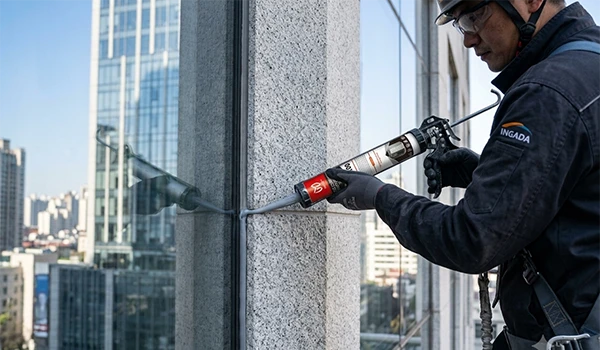
Choosing the right exterior facade sealant can determine whether a high-rise building stays weatherproof or suffers costly structural leaks. For decades, traditional silicone was the default choice for exterior expansion joints. However, advanced silane-modified polymers (MS Polymers) are rapidly shifting the industry standard. For architects, distributors, and engineering contractors, understanding the technical differences between these two chemistries is essential for safeguarding modern high-movement building envelopes.
The Problem with Traditional Silicone
While standard silicone offers strong weatherproofing capabilities, it introduces severe operational limitations on the field. Traditional silicone sealants are completely unpaintable, forcing project managers to source exact color matches or compromise on aesthetic designs. More critically, silicone migration tends to leach fluid plasticizers over time, staining premium natural stone, marble, and wood facade panels. Additionally, silicone’s lower structural tear strength makes it highly susceptible to cohesive failure under intense wind loads and structural shifting.
Technical Explanation: MS Polymer Advantages
Advanced MS Polymer technology combines the high mechanical strength of a polyurethane with the long-term environmental durability of a silicone, completely eliminating their respective weaknesses. Engineering data shows that premium solutions like INGADA MS-650 provide an exceptional Class 50 (±50%) movement capability alongside an elongation at break of ≥780%.
Unlike silicone, MS Polymers are 100% solvent-free and paintable, allowing seamless integration into any architectural color scheme. They operate on a completely non-staining, zero-migration mechanism, maintaining clean facade joints without chemical staining. Furthermore, they exhibit excellent primerless adhesion to diverse porous and non-porous substrates, retaining dynamic flexibility across extreme thermal spans ranging from –40°C to 90°C.
Performance Comparison Table
| Performance Parameter | Traditional Silicone | INGADA MS Polymer (MS-650 / MS-635) | Authority Source / Test Method |
| Movement Capability | Class 20 to Class 50 (±20% to ±50%) | Class 35 to Class 50 (±35% to ±50%) | ASTM C920 / ISO 11600 |
| Paintability & Aesthetics | Completely unpaintable; attracts dirt | Fully paintable and sandable | Manufacturer TDS |
| Substrate Migration | High risk of fluid migration (stains stone/wood) | Zero migration (100% white-oil & plasticizer-free) | ECHA REACH Compliance |
| Fatigue Resistance | Standard cyclic recovery | Validated up to 5,000 cycles (Seismic tested) | ASTM / National Technical Center |
| Eco-Compliance | Variable VOC emissions | Near odorless, solvent-free, French VOC A+ certified | CEN / EN Standards |
High-Movement Exterior Applications
Engineered MS Polymers are purpose-built for the most demanding infrastructural environments. Their primary applications include:
- Super-Tall Curtain Walls & Facades: Managing heavy structural displacement and high wind pressure on high-rise building joints.
- Seismic Expansion Joints: Providing high-frequency fatigue resistance in active fault zones.
- Mega-Infrastructure Joints: Sealing long-span bridges, tunnels, and precast concrete prefab building joints.
FAQ
Q: Can MS Polymer sealants completely replace silicone in exterior applications?
A: Yes. MS Polymers match the UV stability of premium silicone while adding the benefits of paintability, zero staining on natural stone, and significantly higher tear resistance.
Q: Do MS Polymers require a primer for exterior concrete or metal joints?
A: No. Formulations like MS-635 and MS-650 offer primerless adhesion to most common building materials, reducing onsite labor times.
Q: How do MS Polymers behave during extreme freezing conditions?
A: They maintain full low-temperature flexibility down to $-40^{\circ}C$, easily absorbing freeze-thaw cycles and ice loads without cracking.
Conclusion
When specifying sealants for high-movement exterior facade joints, MS Polymer chemistry offers clear technical superiority over traditional silicone. By eliminating substrate staining, allowing post-installation painting, and delivering seismic-tested fatigue life, it minimizes long-term maintenance costs. For distributors and global engineering contractors looking to optimize project lifespans while lowering material procurement costs by 30-40% compared to legacy European brands, upgrading to commercial-grade MS Polymers is the logical modern standard.
#ConstructionInnovation #CurtainWall #FacadeEngineering #MSPolymer #B2BSupplyChain #CivilEngineering
Discover more from INGADA The Ultimate Bonding Expert
Subscribe to get the latest posts sent to your email.