Quick Answer
A complaint arrives as a sentence: “the sealant failed.” That sentence contains almost no usable information, and the instinct to interpret it immediately is what ruins the investigation.
Three categories must be kept apart from the first hour:
| Statement type | Example | Status |
|---|---|---|
| Observed fact | The bead has separated from the frame along 400 mm | Recorded |
| Possible contributing factor | The frame was powder-coated and not abraded | Unconfirmed |
| Verified finding | Cohesive failure within the bead, confirmed by examination | Evidenced |
Most disputes escalate because the second category gets reported as if it were the third. A buyer who says “surface preparation was inadequate” on day one has made an accusation they cannot yet support. A buyer who says “preparation method is unknown and needs checking” has opened the right question.
1. Record the Symptom Before Anyone Explains It
The first record should contain no causes at all — only what is observable.
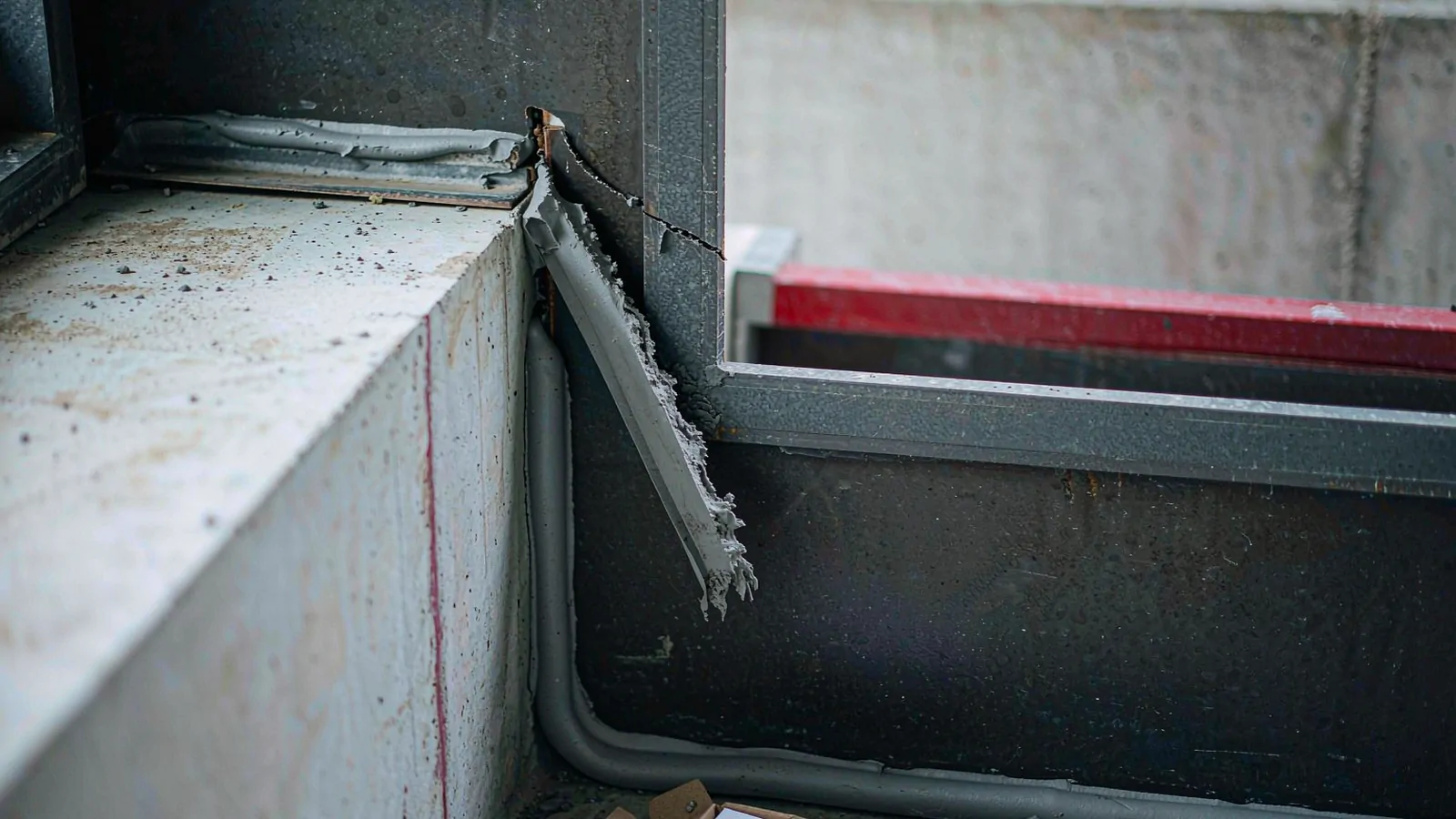
Useful entries: what was seen, where, when it was noticed, how many joints or units are affected, and whether the condition is progressing. Photographs should be taken before anything is cleaned, cut open or repaired.
The location matters more than it looks. A complaint that affects every joint on one elevation is a different investigation from one that affects three joints scattered across a building, and the distinction is only available if the pattern was recorded at the start.
Write the symptom in the customer’s own terms first, then translate it into a technical description. The translation is a hypothesis, and should be labelled as one.
2. Fix the Batch Before the Site Is Cleaned
Traceability has a short window. Once the affected joints are cut out and the site is cleaned, the only evidence left is what was written down and what was kept.
Collect within the first visit:
- Product model and batch or lot number, from the carton if the joint itself is gone.
- Delivery and invoice reference, so the batch can be tied to an order.
- Quantity received and quantity used.
- Remaining unused material from the same batch, and where it has been stored.
- Which model was used at each affected location, if more than one was in play.
That last point decides whether this is a batch question or a project question. If three models were used on the same elevation and only one is failing, the batch matters. If all three fail on the same detail, the detail matters.
3. Photograph What a Later Reader Will Need
The purpose of photographs is to let someone who was never on site reach the same conclusion. That requires three types of image, not one:
Context — the elevation or room, showing where the joint sits in the assembly.
The symptom — close enough to see whether separation is at the substrate, within the bead, or at a bonded interface.
The evidence trail — the label, the batch code, the carton, the unused material.
Date-stamp or link every image to the inspection record, and identify location. A folder of unlabelled close-ups is not evidence; it is decoration.
If laboratory examination is intended, agree the sampling, packaging and chain-of-custody procedure before anything is cut. A sample taken without a documented chain is easy to challenge later.
4. Reconstruct the Conditions, Including the Ones Nobody Recorded
Sealant behaviour depends on the system around it, and most of that system is decided before the tube is opened.
Reconstruct, and mark unknowns as unknowns:
- Substrates on both faces, including coatings and their age.
- Joint width and depth as built, not as drawn.
- Preparation method and the interval before sealing.
- Primer, backing rod, and any other component in the joint.
- Installation date, and the weather during and after.
- Cure time before exposure to water, traffic or cleaning.
- Cleaning agents and maintenance history since.
The gap between “as designed” and “as built” is where a large share of failures live. A joint drawn at 12 mm and built at 5 mm changes the movement the sealant must absorb, and no product data sheet can compensate for that.
Where the substrate is concrete, masonry or a lightweight block, the chemistry question often comes up early — see how substrate compatibility is assessed.
The same reconstruction is what an installation check would have recorded at the time. If the project ran one, the sealant installation quality checklist is where those observations should sit.
5. Ask Whether the Batch Was Ever Approved
A complaint investigation should check its own paper trail before blaming the supplier.
Was this model ever evaluated for this substrate? Is there a sample record, and does it name the batch? Did the project approve the product, or was it installed on the assumption that a similar product was acceptable?
Three uncomfortable but useful findings can come out of this check:
- The product was approved for a different substrate.
- The product was approved, but a different batch was supplied.
- Nothing was ever approved, and the complaint is the first formal review.
Each of these changes the conversation completely, and each is answered by documentation rather than argument. How that documentation should look at the front end is covered in evaluating samples before supplier approval.
6. Agree the Investigation Before Agreeing the Outcome
Once evidence is collected, the parties should agree what will be done, by whom, and in what order — before anyone discusses remedy.
A workable sequence:
- Review the product documentation against the reported symptom.
- Examine the retained sample and, where relevant, the unused material.
- Inspect the installation, preferably with both parties present.
- Identify which tests, if any, would distinguish between the remaining hypotheses.
- Assign each action to a named party with a date.
- Record the finding and the corrective action.
The value of agreeing the sequence first is that it prevents the most common procedural failure: commissioning a test that cannot answer the question being argued about.
7. The Complaint File
Twelve fields, one file. This is the difference between a complaint that closes and one that recurs.
| Field | Content |
|---|---|
| Reference | Internal identifier, dated |
| Product | Model and batch or lot |
| Order link | Invoice, delivery note, quantity |
| Customer and project | Where and for whom |
| Symptom | Neutral description, no causes |
| Location and extent | Joints, elevations, area affected |
| Evidence | Photographs, retained sample, records |
| Conditions | Substrates, joint dimensions, preparation, weather |
| Storage history | Location, duration, known deviations |
| Investigation | Hypotheses, tests, responsible parties |
| Finding | What was established, and on what basis |
| Disposition | Action taken, closure date, owner |
A file built this way does two jobs. It resolves the current complaint, and it creates the dataset that reveals whether the problem is recurring, batch-specific, or application-specific.
8. Use the Pattern, Not the Incident
One complaint tells you almost nothing about a supplier. Ten complaints with a shared cause tell you a great deal.
Track, across complaints: the symptom type, the application, the batch, the resolution time, and whether the cause was product, application, storage or documentation. After a year, the distribution of causes is a procurement tool — it shows where in the chain the losses actually occur.
It also protects against the wrong conclusion. A supplier with three complaints on a new product line and none on the established range is a different case from one with three complaints spread across everything.
9. Prevent the Next One by Closing the Loop
The last step is the one most often skipped: feeding the finding back into the process that produced it.
If the cause was substrate-related, the substrate description in the inquiry needs to change. If it was preparation-related, the installation checklist needs a line. If it was batch-related, the goods-in record needs the batch field it was missing.
A complaint that closes without changing anything upstream will be filed again, probably within the year, probably by a different customer.
Conclusion
A sealant complaint is an evidence problem before it is a liability problem. Record the symptom without interpreting it, fix the batch before the site is cleaned, reconstruct the conditions including the unknowns, and keep facts separate from hypotheses.
Buyers who do this get two things: a complaint that can actually be resolved, and a record that shows whether it was one incident or a pattern.