How to Select Adhesives for Interior Panels, Trim and Decorative Components

Quick Answer
Interior panel and trim work fails in three ways, and each has a different cure:
| Failure | What happened | The property that prevents it |
|---|---|---|
| Component slid or dropped before cure | Initial grab too low for a vertical surface | High initial tack, measured in seconds |
| A ridge visible through the panel face | Adhesive applied in beads instead of full spread | Application method, not product choice |
| Trim lifted months later | Bond to a contaminated or painted surface | Surface preparation and adhesion test |
Note that only the first is a product specification question. The second is technique, the third is site discipline. Buying a stronger adhesive fixes one of three.
1. What Interior Bonding Actually Demands
Interior components are light, thin and visible. That combination sets the requirement:
- Light but loaded. A wall panel weighs little; a mirror, a stone trim or a decorative shelf bracket does not. The adhesive must carry the actual load, not the average one.
- Thin and unforgiving. A 3 mm panel telegraphs any hard spot. Adhesive ridges show as lines on the finished face, permanently.
- Vertical. Gravity acts during the whole open time, not just at the start.
- Visible. Any staining, squeeze-out or discolouration is a defect, not a cosmetic issue.
2. Grab Is the First Filter on a Vertical Surface
On a horizontal floor you can wait. On a wall you cannot: the component must stay where it is put, without props, from the moment of contact.
This is why a bonding adhesive is specified by initial positioning grab rather than by tensile strength. In this range, MS-35 is the grade for that job: positioning grab ≤ 15 seconds, shear strength ≥ 3.0 MPa, Shore A hardness 55 ± 5, service range −30 to +100 °C. The hardness is deliberate — this is a load-bearing bond, not a movement joint.
Two distinctions worth keeping straight:
- A bonding adhesive is not a sealant. It has no displacement class and must not be used to seal a moving joint, however convenient that would be on site.
- A sealant is not a bonding adhesive. Even a high-strength sealant will creep under a sustained vertical load.
Where a component is both fixed and sealed — a stone sill, for example — that is two products and two details, not one compromise.
3. Telegraphing: the Defect That Cannot Be Fixed Later
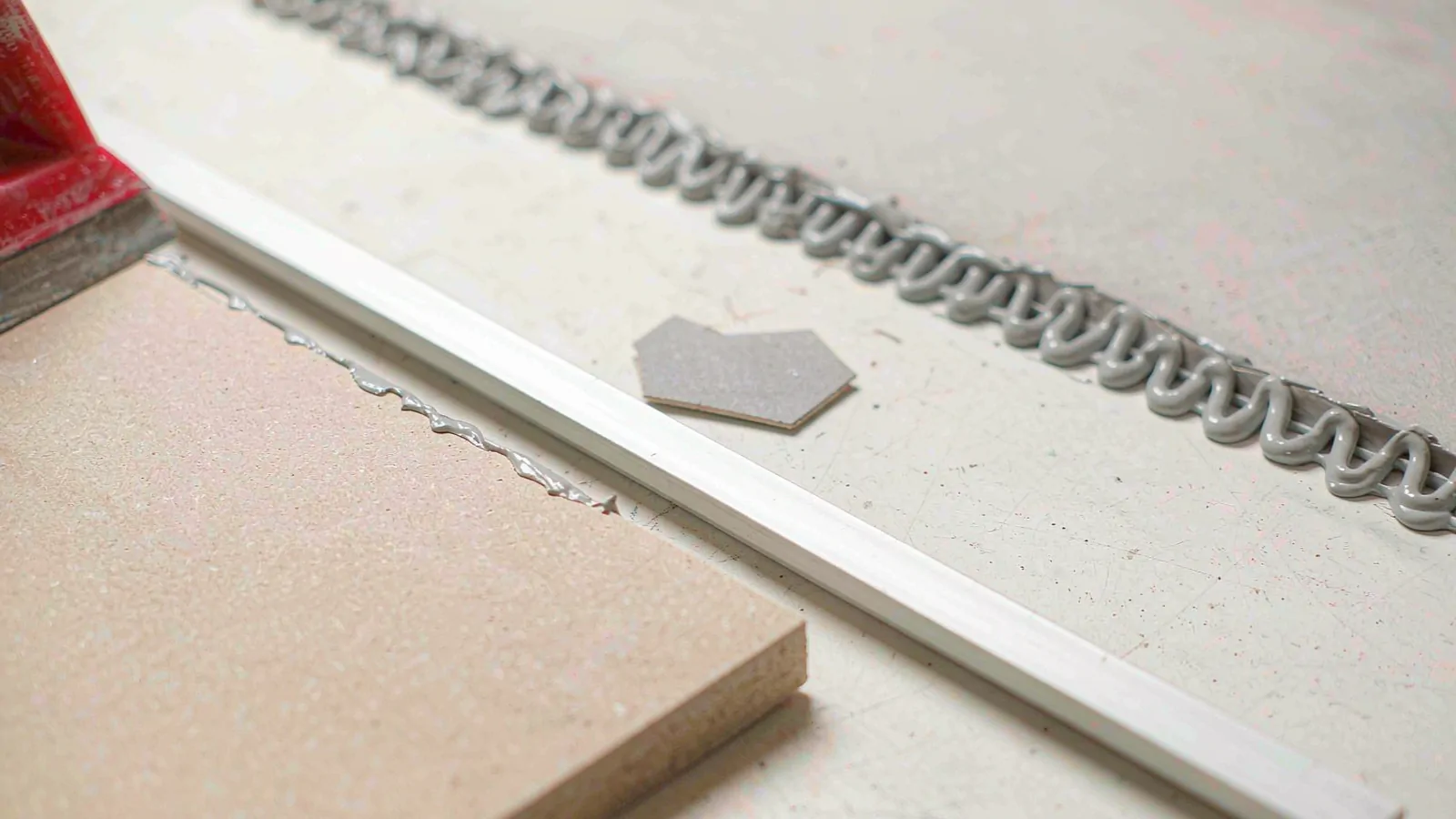
A visible ridge under a thin panel means the adhesive was applied in beads. There is no repair short of removing the panel.
The controls are mechanical:
- Full-spread comb application on flat panels, with a notch size matched to the panel thickness and flatness.
- Beads only where the substrate is uneven and the panel is thick enough to bridge — and never on a visible thin face.
- Support during cure where the panel is large or the wall is out of tolerance.
- Check flatness first. Adhesive is not a levelling compound; a 5 mm hollow becomes a visible dip.
4. Substrate Pair Decides the Chemistry
| Substrate | Consideration |
|---|---|
| MDF, plywood, particleboard | Porous and moisture-sensitive; seal cut edges, avoid water-based systems that swell the core |
| Gypsum board, plaster | Weak surface layer; the bond can fail inside the substrate rather than at the interface |
| PVC, laminate, melamine | Low surface energy; adhesion test before production work |
| Aluminium trim, coated metal | Coating-dependent, as on facades; test the actual finish |
| Natural stone trim | Staining risk — use a formulation with a no-staining declaration for that model |
| Glass, mirror | Mirror backing is delicate; use a neutral-cure product and never an acid-cure one |
Where the substrate is concrete, masonry or ALC, the same logic as external work applies and an MS polymer is the usual answer — MS-625 is the low-modulus grade with concrete adhesion ≥1.2 MPa and a paintable finish.
5. Movement: Small Components, Real Movement
Interior components move less than facades, but not zero:
- Long aluminium trim expands measurably over a few metres under direct sun through glazing. Butt joints without a gap telegraph into buckled trim.
- Timber trim moves with room humidity, seasonally.
- Different materials side by side — a stone sill against an aluminium frame — move differently, and a rigid bond concentrates the difference at the weakest interface.
The practical rule: bond rigidly where the component is short and the substrate is stable; leave a movement gap and seal it where the run is long or the materials differ.
6. Indoor Requirements Are Part of the Specification
Interior work is where indoor air-quality considerations legitimately apply: low VOC, no phthalate plasticiser, low odour during cure. For sensitive environments — hospitals, schools, occupied offices — these are selection criteria, not marketing.
Where a project requires formal indoor documentation, confirm the set per model rather than assuming it applies across a range. Indoor and outdoor certification sets are different, and quoting the wrong one is a credibility problem in a submittal review.
7. Specification Checklist
- Component and its weight, including anything hung from it.
- Substrate pair, with the surface finish named.
- Vertical or horizontal, and whether temporary support is possible.
- Panel thickness and visibility of the bonded face.
- Service conditions — humidity, sun exposure through glazing, cleaning regime.
- Indoor documentation required for the project.
- Cure window available before the next trade or handover.
The procurement sequence around these decisions — how many products a project should standardise on — is covered in the flooring and interior bonding procurement guide. The full model list sits under the product categories.
Discuss Your Interior Fixing Requirement with INGADA
If you are selecting an adhesive for panels, trim or decorative components, send the component and its weight, the substrate pair with finishes, whether the fixing is vertical, the panel thickness and the indoor documentation the project requires.
INGADA can confirm which grade gives the grab and shear the detail needs, where a full-spread application is mandatory, and where a movement gap has to be designed in rather than bonded out.
Suitability depends on the substrate pair, component weight and fixing orientation. Confirm adhesion on the actual surfaces before production work.