How to Specify Mold-Resistant Sealants for Kitchens, Bathrooms and Wet Areas

Quick Answer
Mold on a wet-area joint is usually a joint problem, not a cleaning problem — and the first specification decision is not “which brand” but “how wet is this joint, and does it need a soft joint or a hard surface”.
Those two questions split kitchens and bathrooms into three different product requirements, and choosing by appearance or by habit rather than by severity is the most common cause of a joint that fails within a year. Mold resistance should be the first filter, not the last: in this sector, black spotting on the silicone is the single most frequent complaint, and once the joint has discoloured from behind, cleaning the surface does not fix it.
1. Why Wet-Area Joints Fail
Kitchen and bathroom joints combine the conditions that degrade a sealant fastest:
- Continuous or repeated water contact, often with soap, oil and cleaning agents
- Warm, humid air with limited ventilation — the enclosure does not dry out between uses
- Small joint dimensions with high relative movement — a 6 mm bead between glass and tile must absorb the same movement as a much wider façade joint
- Substrate pairs that move differently: ceramic and glass, tile and metal, acrylic and tile
- Poor access for maintenance once the room is in use
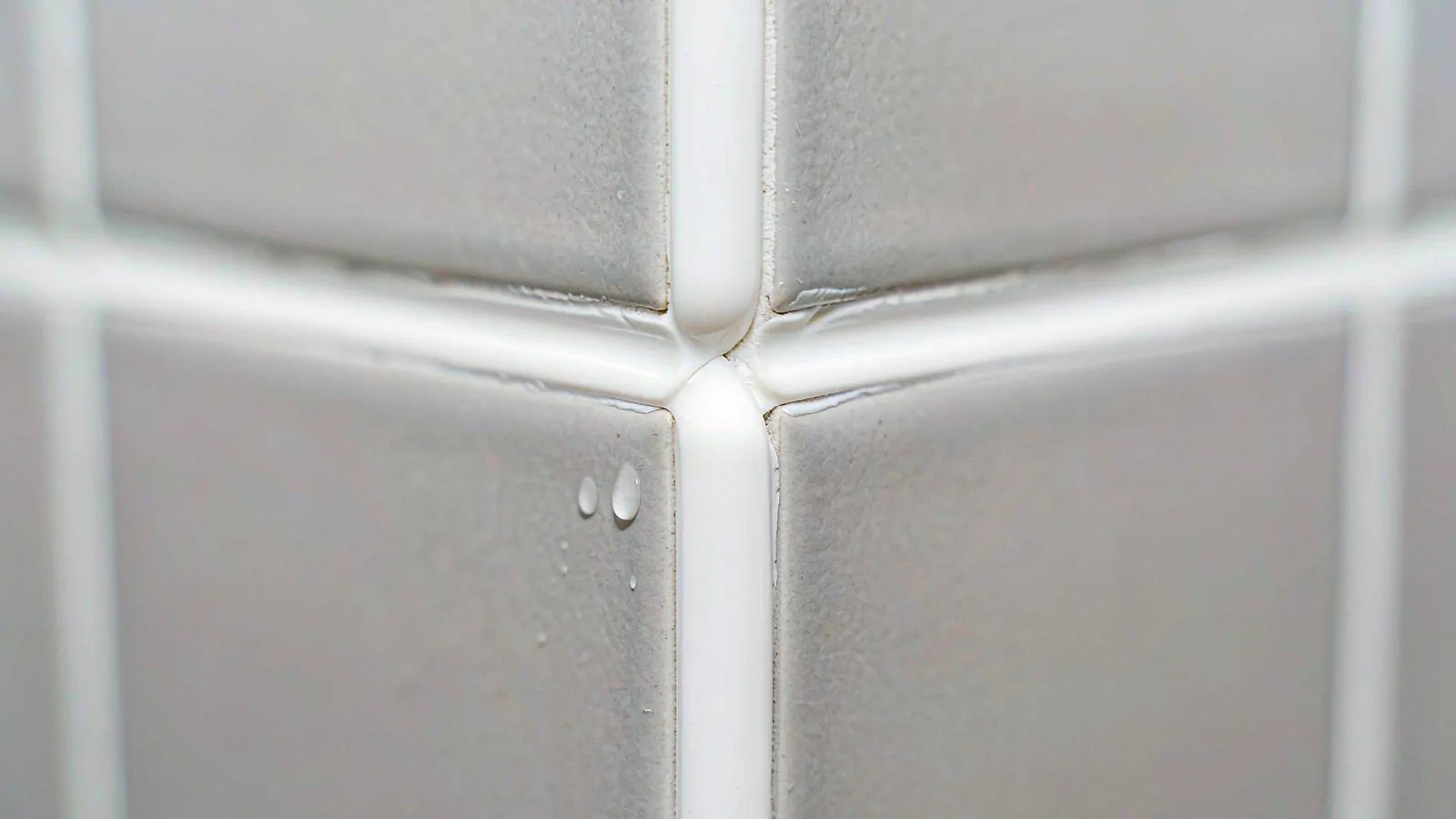
The visible symptom is black spotting along the joint edge. The underlying cause is usually moisture retained at or behind the bond line, which the surface of the sealant cannot prevent — but which a poor grade of sealant accelerates.
2. Reading a Mold-Resistance Claim
Claims in this category range from testable to purely descriptive. Before approving a product, establish which type you are looking at.
| Claim | What it tells you | What it does not |
|---|---|---|
| “Mold-resistant” / “mold-proof” | The formulation is intended to resist fungal growth | Nothing about test method or result |
| A named grade, e.g. V0 | A grade exists against a defined method | Whether that method is the one your project requires |
| “Antibacterial” | A different property | That it resists mold — the two are tested differently |
| “Easy to clean” | A surface property | Any resistance to fungal growth at all |
“V0” in this context refers to a mold-resistance grade, and the method used in the INGADA range is ASTM G21. Some products state a multiple of that grade — for example 20× V0 means twenty times the efficacy of a standard V0 grade, which is how the strongest product in the range is positioned.
A practical rule: write the standard, the grade and the date of the evidence into the specification. A grade quoted without its method cannot be compared across suppliers, and it is the first thing a technical buyer will question.
3. The Decision That Matters Most: Soft or Hard
This is where most wet-area specifications go wrong, and it is not about mold resistance at all — it is about the physical character of the cured joint.
Wet areas contain two different kinds of joint:
Joints that must move. Worktop to splashback, bath rim to tile, basin to wall. These follow structural movement and thermal expansion. They need an elastic sealant that deforms and recovers — in this range, either a product classified at Class 25 for movement, or one documented at roughly 15–28 Shore A. Note that movement class and hardness are separate properties: a sealant can follow a moving joint without being soft to the touch.
Joints that must stay clean. Toilet base, shower enclosure perimeter, areas of continuous wetting and soiling. Here the enemy is a porous, soft surface that traps dirt and cannot be wiped. These need a hard, glossy surface, typically ≥80 Shore A, which behaves more like a ceramic joint than a rubber one.
Adding a soft elastic sealant to a toilet base because it is “the mold-resistant one” produces a joint that discolours, cannot be scrubbed, and gets replaced within a year. Adding a hard sealant to a bath rim produces a joint that cracks when the bath flexes.
Both requirements are legitimate. They are simply not the same product.
4. Three Product Requirements, Not One
The INGADA wet-area range is organised around those two axes plus the environmental and finishing requirements of the project:
| Requirement | Product | Movement / hardness | Mold | Why this one |
|---|---|---|---|---|
| Standard kitchens and bathrooms | MS-50P | Class 25; hardness per TDS | Tested to ASTM G21 / ISO 846 Method B | Purpose-built kitchen-and-bath MS polymer: bath rims, shower enclosures, sinks, worktop joints and tile joints; solvent-free, low odour, paintable |
| Premium, low-odour, sensitive substrates | SR-15 | ±25% / 15–25 Shore A | Mold-resistant | Alcohol-cure, MEKO-free, low odour, low VOC; non-corrosive to copper, brass, stainless, anodised aluminium and marble |
| High-wetting zones | MS-50A | ≥80 Shore A / tensile ≥2.5 MPa | 20× V0 grade (ASTM G21) | Hard glossy surface, plasticiser-free, oil and stain resistant, wipeable; service range -40°C to +120°C |
The first row carries two requirements that often arrive together in practice: a specification that is both kitchen-and-bath specific and overpaintable. That combination is the reason an MS polymer sits in the standard tier rather than a silicone — the joint can be coated to match the wall without a second product.
Two specification notes that come out of this table:
- Paintability decides the chemistry. Silicone cannot be overpainted — paint will not adhere and will peel. If any joint in the room must be coated to match the wall, that joint has to be an MS product, whatever the rest of the room uses.
- Plasticiser-free matters in porous surroundings. Plasticiser migration from a soft sealant into natural stone or an adjacent finish shows as a dark halo that cannot be cleaned. MS-50A is documented as plasticiser-free, which is the reason it is specified next to stone and in clinical environments.
Application guidance for kitchens, bathrooms and shower rooms is grouped under interior and wet areas.
5. Where Transparency Is the Requirement
One more case sits outside the three above: the joint must be invisible.
Frameless glass shower screens, mirrors, display cabinets and high-end marble or designer tile finish to a point where a coloured bead breaks the visual line. The INGADA product positioned for this is MS-88L, a crystal-clear MS polymer.
Documented properties: transparency maintained without yellowing or clouding, elongation ≥200%, movement capability ±25%, hardness around 25 Shore A, service range -40°C to +90°C, and adhesion to glass, ceramic tile, metal, acrylic and PVC. Typical applications in the range documentation are frameless glass sealing, translucent interior joints, and internal glazing.
Specify it for transparency, not for mold resistance. Its documented strength is optical, and its hardness (25 Shore A) makes it a soft joint — which is correct for a glass-to-tile interface that moves, and wrong for a toilet base. If a project requires a documented mold grade on a transparent joint, ask for the test method and result for that exact model before writing it into the specification.
6. Five Mistakes Worth Avoiding
| Mistake | What happens |
|---|---|
| Using a general weatherproof sealant in a kitchen or bathroom | No mold-resistant design; discolours within months and generates callbacks |
| Using a soft sealant in a high-wetting zone | Soft surface traps dirt, cannot be scrubbed; the joint is replaced rather than cleaned |
| Trying to paint a silicone joint | Paint will not adhere; it peels and looks worse than the original colour |
| Ignoring plasticiser migration | Long-term bleed stains adjacent stone and finish, and can cause loss of adhesion |
| Treating the surface only | Cleaning mold off a joint does not address the grade of product; the growth returns |
7. What to Put in the Specification
For each joint in the room, record:
- Location and whether it must move or must stay clean
- Substrate pair and surface finish on each side
- Continuous wetting, intermittent wetting, or dry
- Colour and appearance requirement, including whether the joint must be invisible
- Whether the joint will be overpainted
- Required mold grade with its test method
- Service temperature if the location is unusual
- Cleaning agents expected in service
- Presence of natural stone or other plasticiser-sensitive materials
That list is short, and filling it in is the difference between a specification and a product name.
Frequently Asked Questions
Will a mold-resistant sealant stop mold coming back?
It reduces the material’s own susceptibility to fungal growth. Recurrence usually means water is still reaching the bond line — a joint detail, substrate or ventilation issue rather than a product failure.
Is there a difference between mold-resistant and antibacterial?
Yes. They are different properties, tested differently, and should not be used interchangeably in a specification. A product may be documented for one and not the other.
What does “V0” mean on a sealant?
In this range it is a mold-resistance grade, tested by ASTM G21. Products may then state a multiple of that grade — for example 20× V0. Always ask for the standard, the grade and the date of the evidence.
Can I use one sealant for the whole bathroom?
Only if the joints have the same movement and cleaning requirement. A bath rim needs elasticity; a toilet base needs a hard wipeable surface. Specifying both with one product means one of them is wrong.
Why can’t I paint over a silicone joint?
Silicone does not accept paint. If the joint must be overcoated, the specification has to move to an MS product such as MS-50P.
Discuss Your Wet-Area Requirements with INGADA
If you are specifying kitchen, bathroom or shower joints, prepare the joint locations, the substrate pairs, the wetting severity, the colour or transparency requirement and whether any joint will be overpainted before requesting product data.
INGADA can confirm which product documentation applies to each joint and flag what still needs verification before it is written into a specification.
Mold-resistance grades are only comparable when the test method is stated. Confirm the grade and the method for the exact model before approval.