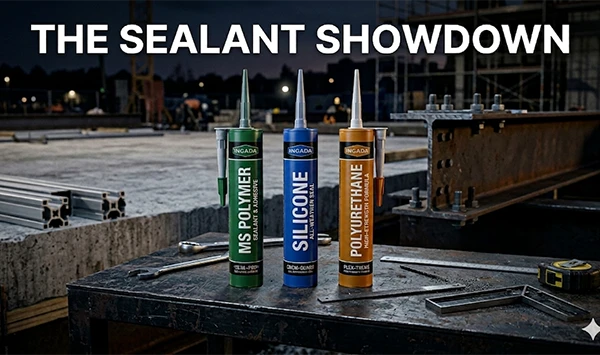
When specifying sealants for construction and industrial projects, the choice often comes down to a fundamental trade-off: upfront cost versus long-term performance. MS Polymer (Modified Silane) sealants have gained significant traction in recent years, but debates continue about whether they truly outperform traditional silicone and polyurethane alternatives.
This article examines the real-world differences in performance, durability, and cost — and where each technology fits best.
1. What Is MS Polymer?
MS Polymer (modified silane or silyl-modified polymer) is a hybrid sealant technology that combines the best properties of silicones and polyurethanes while eliminating many of their drawbacks. Unlike traditional polyurethanes, MS Polymers contain no isocyanates; unlike silicones, they are paintable and low-odor.
BLOK’s MS-77 Series is built on this exact MS Polymer technology, engineered for professionals who need reliable adhesion across multiple substrates.
2. Adhesion to Substrates: Head-to-Head
Adhesion is where the biggest differences emerge. MS Polymers demonstrate superior adhesion to porous and alkaline substrates such as concrete — a key reason they are increasingly specified in prefabricated building systems.
| Substrate | MS Polymer | Silicone | Polyurethane |
|---|---|---|---|
| Concrete | ★★★★★ | ★★★☆☆ | ★★★★☆ |
| Steel | ★★★★★ | ★★★☆☆ | ★★★★☆ |
| Aluminum | ★★★★★ | ★★★☆☆ | ★★★☆☆ |
| Glass | ★★★★☆ | ★★★★★ | ★★★☆☆ |
| PVC | ★★★★☆ | ★★★★☆ | ★★★☆☆ |
Silicone relies heavily on primers for concrete and masonry; polyurethane requires surface preparation and sometimes priming. MS Polymer bonds directly to most substrates without primer — reducing labor and specification risk.
💡 Professional Consensus
“The industry is moving toward MS Polymer for prefabricated building systems. The key advantage isn’t just performance — it’s specification simplicity. One product, multiple substrates, no primer. That reduces labor error and project risk in ways the price tag doesn’t show.”

3. Weather Resistance & Durability
Silicone has long been the gold standard for outdoor weather resistance. Its inorganic Si–O backbone gives it exceptional UV stability and temperature tolerance (−50°C to +200°C for high-grade silicones).
MS Polymer has narrowed the gap significantly. Modern MS formulations now offer:
- UV resistance: 10–15 years of exterior exposure without cracking
- Temperature range: −40°C to +90°C (suitable for most climates)
- No bubbling or blistering on damp substrates
| Property | MS Polymer | Silicone | Polyurethane |
|---|---|---|---|
| UV Resistance | Very Good | Excellent | Poor–Fair |
| Temp. Range | −40°C ~ +90°C | −50°C ~ +200°C | −40°C ~ +80°C |
| Service Life (outdoor) | 10–15 years | 20+ years | 8–12 years |
| Damp-substrate application | ✅ Yes | ⚠️ Limited | ❌ No |
4. Paintability & Aesthetics
This is where MS Polymer clearly wins — and where specifiers frequently switch away from silicone.
| Property | MS Polymer | Silicone | Polyurethane |
|---|---|---|---|
| Paintable | ✅ Yes (most paints) | ❌ No | ⚠️ Limited |
| Odor during application | Very low | Strong (acetoxy) | Strong (isocyanate) |
| VOC content | Low / Very low | Medium–High | High |
| Stain / fogging risk | None | High (porous surfaces) | Low |
Silicone cannot be painted — paint simply does not adhere to its low-surface-energy backbone. This forces designers to accept visible bead lines or use color-matched silicone (expensive and limited colors). MS Polymer accepts water-based and solvent-based paints, making it the preferred choice for interior and architectural applications where aesthetics matter.
5. Curing Speed
A common criticism of MS Polymer is slower skin-over and cure time compared to silicone. Here’s how they compare in practice:
| Sealant Type | Skin-Over Time | Full Cure (10mm bead) |
|---|---|---|
| Silicone (neutral) | 10–20 min | 24–48 hours |
| MS Polymer | 20–40 min | 48–72 hours |
| Polyurethane | 30–60 min | 3–7 days |
Practical impact: For production-line or high-speed installation environments, silicone’s faster cure can be advantageous. For most construction schedules, the difference is manageable and outweighed by MS’s other benefits.
6. The Cost Question: Is the 20–30% Premium Justified?
MS Polymer sealants typically cost 20–30% more than comparable silicone products. Is the premium justified? The answer depends entirely on the application.
✅ When MS Polymer Delivers Better Value
- Multi-substrate projects — one MS product replaces silicone + primer + PU in many cases
- Indoor applications — no odor means occupied-space use without evacuation
- Paintable requirement — eliminates need for color-matched specialty silicones
- Prefab / modular construction — superior concrete and metal adhesion reduces callback risk
- Low-VOC projects — meets green building certifications (LEED, BREEAM) more easily
❌ When Silicone Remains the Cost Leader
- Exterior glazing / structural — where silicone’s proven 20+ year track record justifies its use
- Sanitary / bathroom — fungicidal silicones are cost-effective and proven
- High-movement joints in extreme climates — silicone’s elasticity range is still superior
- Budget-constrained projects — where initial material cost dominates specification

7. Industry Perspectives: Three Views
✅ Pro-MS View
“MS Polymer is the most versatile sealant technology available today. No isocyanates, no odor, paintable, and it bonds to almost everything we throw at it — concrete, steel, aluminum, PVC. For modern construction, it’s not even a debate.”
❌ Skeptical View
“Silicone still outperforms in weatherability. If you’re sealing a façade that needs to last 20 years, I’m reaching for silicone. MS cures slower and costs more — show me the ROI on that premium.”
💡 Professional Consensus
“In prefab construction, MS Polymer is the trend — its ability to bond concrete, steel, and aluminum without primers gives it a clear specification advantage. The question isn’t whether MS is ‘better’ than silicone; it’s which one fits the specification.”
🏷️ BLOK MS-77 Series: MS Polymer Technology in Action
BLOK’s MS-77 Series is formulated specifically for the demands of modern construction, delivering the versatility of MS Polymer in a professional-grade formulation:
- 🏗️ Substrate versatility: Concrete, steel, aluminum, PVC, masonry — no primer required on most surfaces
- 🎨 Fully paintable: Compatible with most water-based and solvent-based paints
- 🌿 Low VOC: Complies with stringent indoor air quality standards
- 📐 Movement capability: ±25% accommodation of joint movement
- 🕐 Neutral cure: Odor-free — suitable for occupied buildings
Whether you are specifying for prefab modules, cladding systems, or general construction joints, MS-77 delivers the balance of performance and workability that modern projects demand.
Conclusion: It’s Not Either/Or
Application-Led Specification Guide
- Choose MS Polymer for: indoor seals, paintable joints, multi-substrate assemblies, prefab construction, low-odor requirements, and green building projects.
- Choose Silicone for: exterior glazing, sanitary applications, extreme weather exposure, and maximum movement joints.
- Choose Polyurethane for: heavy-duty civil engineering joints (where MS is not yet specified).
The 20–30% price premium for MS Polymer is not a penalty — it’s the cost of versatility, safety, and specification simplicity in an increasingly complex construction landscape.
Need Help Specifying the Right Sealant?
Our technical team can help you evaluate substrate compatibility, movement requirements,
and cost scenarios for your specific project.Contact BLOK Technical Team →
Related Articles:
MS-77 Technical Specification Guide | How to Select the Right Sealant for Your Project | Sealants in Prefab Construction: What Specifiers Need to Know
#MS Polymer #Silicone Sealant #Construction Sealant #MS-77 #Prefab Building #Sealant Comparison
Discover more from INGADA The Ultimate Bonding Expert
Subscribe to get the latest posts sent to your email.