Blog

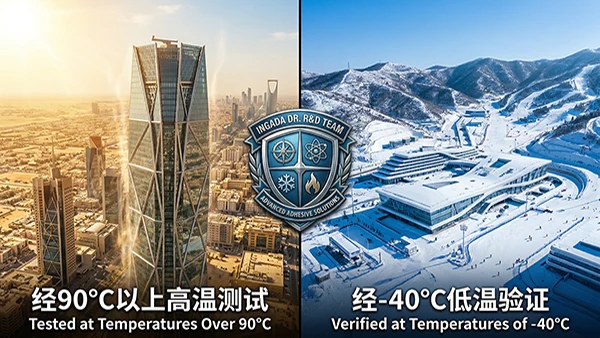
In regions like the Middle East or Southeast Asia, environmental stress is non-stop. Standard sealants are the “weak link” in high-rise building facades. They often succumb to molecular rigidification within 24 months, leading to cohesive failure and water ingress. If your current solution isn’t specifically designed for thermal stability, it’s not a question of if it will fail, but when.
Stop treating sealants as a commodity. For high-stakes architectural facades, stone cladding, and weatherproof joints, invest in modulus stability. Your sealant must remain elastic and non-yellowing, matching the thermal movement of substrates from -40°C to +90°C.
INGADA MS Weatherproof Sealants feature an engineered silyl-terminated polyether backbone. It offers superior UV resistance without the staining common with silicones on natural stone. Proven performance in extreme environments, including 2022 Winter Olympics venues—if it survives ice and heat stress there, it will secure your facade anywhere.