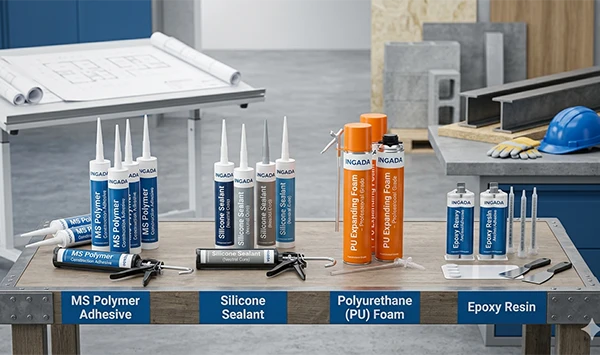
A quick, practical guide to the four main adhesive chemistries — with a decision chart to help you recommend the right product every time.
Quick Comparison at a Glance
Best Use Cases
MS Polymer → Facades, floors, windows, sanitary — versatile all-rounder
Silicone → Glass, bathrooms, high-temperature, perimeter sealing
PU → Structural bonds, automotive, marine, heavy assembly
Epoxy → Metal bonding, flat repairs, chemical-resistant coatings
| Property | MS Polymer | Silicone | PU | Epoxy |
| Paintable | ✓ Yes | ✗ No | ✓ Yes* | ✗ No |
| Movement accommodation | High | High | Medium | Low |
| UV / weather resistance | Excellent | Excellent | Good | Good |
| Chemical resistance | Good | Good | Excellent | Excellent |
| Bond strength | High | Medium | Very High | Extremely High |
| Temperature range | to +120°C | to +300°C | to +100°C | to +80°C |
| Ease of use | ✓ Easy | ✓ Easy | ✗ Tricky | ✗ Tricky |
* Primer usually required for PU. For structural applications, consult INGADA technical team.
The Four Chemistries in Brief
MS Polymer — the European favourite
Modified silane polymer (SMP) blends the best properties of silicone and polyurethane into one. It bonds to almost any substrate without primer, is paintable, stays flexible outdoors, and contains no isocyanates — making it the fastest-growing construction sealant in Europe. Best for: facade joints, floor transitions, window frames, sanitary sealing.
Silicone — the temperature specialist
Unrivalled temperature resistance (-60°C to +300°C) and outstanding UV stability make silicone the default for glass glazing and high-heat zones. Neutral-cure silicone is safe on metals and mirrors; avoid acidic (acetoxy) silicone on bare metal. Not paintable. Best for: window glazing, bathrooms, expansion joints, electrical enclosures.
PU (Polyurethane) — the structural workhorse
Extremely high bond strength and excellent chemical resistance. Cures by reacting with moisture — not suitable for fully enclosed dry joints. Slower cure (24–48 h) and requires careful handling. Best for: automotive structural bonding, marine assembly, civil engineering sealing, heavy equipment assembly.
Epoxy Resin — the precision strength option
Two-component systems delivering the highest bond strength of all four chemistries. Rigid and gap-filling once cured — will crack under movement. Requires precise mixing and PPE during application. Best for: metal structural bonds, stone/concrete repairs, tooling, marine hull bonding.

Pick the Right Adhesive in 4 Questions
1. Will the joint move or vibrate?
→ Yes: MS Polymer or PU. No movement: any chemistry works.
2. Does it need to be painted over?
→ Yes: MS Polymer or PU. Never paint over silicone — use MS Polymer instead.
3. Is it glass, bathroom, or exposed to high heat?
→ Neutral silicone for glass and wet areas; silicone or MS Polymer for high temperatures.
4. Is maximum chemical or structural strength the priority?
→ PU or Epoxy. Epoxy for rigid flat surfaces; PU for structural bonds needing some flexibility.
Frequently Asked Questions
Q: Can MS polymer be used outdoors?
A: Yes. MS polymer is designed for outdoor use with excellent UV stability, weather resistance, and long-term flexibility.
Q: What is the shelf life of these adhesives?
A: MS polymer: 12–18 months. Silicone: 12–24 months. PU: 9–12 months once opened. Epoxy: 1–2 years unopened.
Q: Which adhesive should I use on a concrete floor?
A: MS polymer is the first choice for concrete floor joints and transitions. It bonds well without primer and stays flexible under foot traffic.
Q: Can I use silicone instead of MS polymer to save cost?
A: Only if the joint is glass, wet, or exposed to high heat. For paintable joints, movement accommodation, or concrete bonding, MS polymer is the correct choice.
Q: Does INGADA provide TDS and MSDS documentation?
A: Yes. All INGADA products include Technical Data Sheets and Safety Data Sheets. CE-compliant documentation is available on request.
Ready to Stock the Full INGADA Range?
We supply all four chemistries — one manufacturer, one relationship, your full adhesive line.
Flexible MOQ for new distributors. Contact our English-speaking export team for samples and quotes.
Email: hua@ingadabondpro.com | WhatsApp: +86 13903061432 | ingadabondpro.com
INGADA Adhesive Solutions — One Supplier, Full Adhesive Range
hua@ingadabondpro.com
ingadabondpro.com
WhatsApp: +86 13903061432
LinkedIn: www.linkedin.com/in/hua-ingada
Discover more from INGADA The Ultimate Bonding Expert
Subscribe to get the latest posts sent to your email.